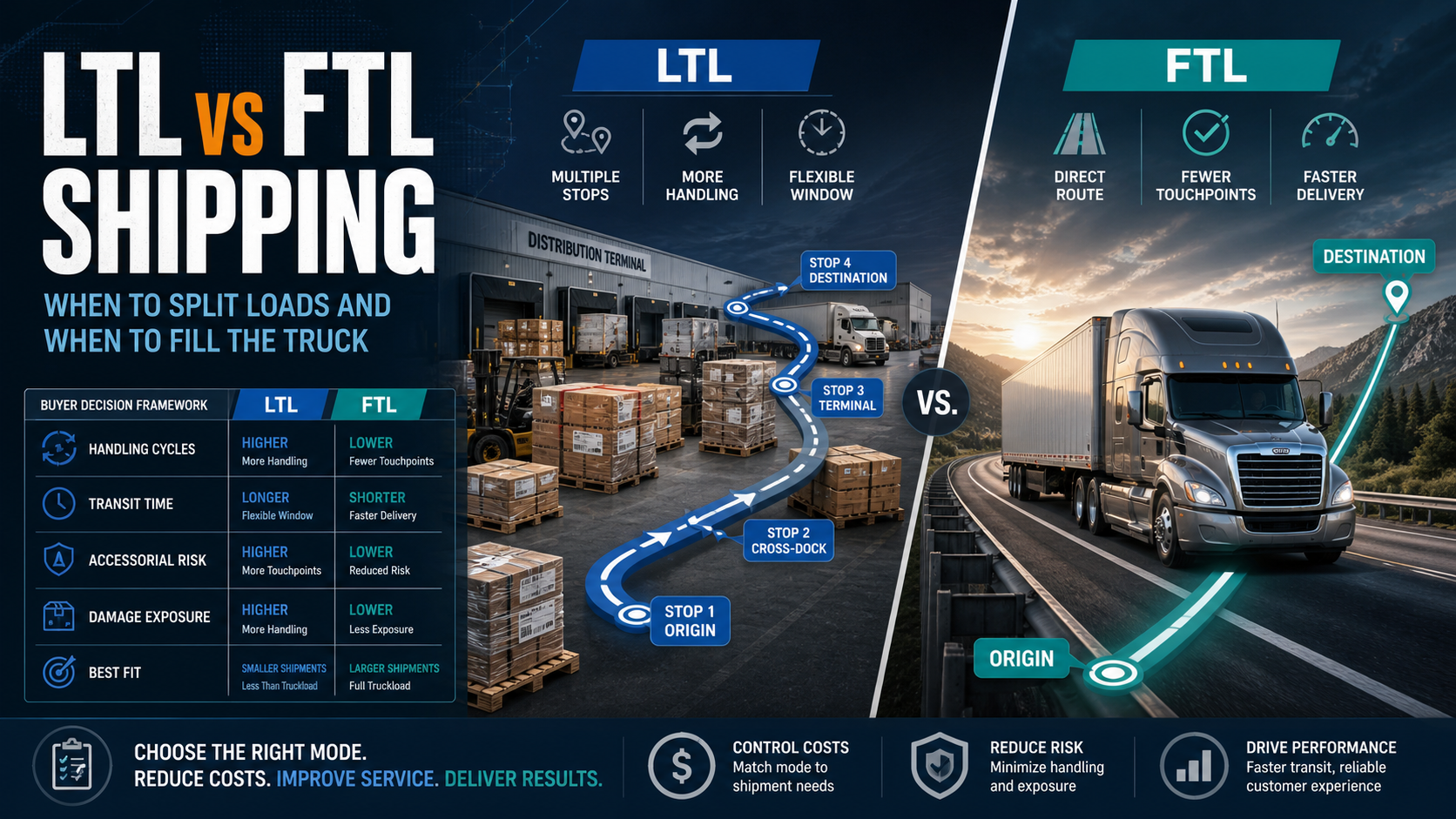
A decision framework for logistics coordinators choosing between less-than-truckload and full truckload shipping based on what actually matters—handling cycles, delivery windows, and total landed cost. Includes a practical comparison table and recommended next steps for common shipper scenarios.

TL;DR

Your load doesn't fill a trailer. Now what? Split it across less-than-truckload (LTL) consolidations and accept the handling cycles—or pay for deadheading full truckload (FTL) that gets there faster with fewer touchpoints. The choice isn't about which is universally "better"—it's about understanding which mode matches your specific shipment's risk tolerance, delivery window, and damage profile.

Why This Matters Now

Shippers increasingly face pressure to consolidate loads into LTL movements. The math looks attractive: you're not paying for an empty truck across a long haul. But that apparent savings disappears when product damage claims, missed windows, or rehandling labor start hitting your cost sheet.

The challenge is that "consolidate more" stopped being universally sound once shippers started moving fragile goods, temperature-sensitive freight, and high-value parts. The same consolidation logic that saves money on robust commodities can actively lose money on shipments where handling intensity drives risk.

This article gives you the decision framework to evaluate your shipment honestly before defaulting one way or another.

The Operational Problem

When LTL creates more cost than it saves:

A shipper moving palletized medical equipment from a Midwest distribution center split their 2,400-pound load across three separate LTL consolidations over two weeks rather than paying for deadheading an FTL shipment. The first consolidation worked fine. The second introduced product-on-product contact damage on boxes that had shifted during the initial handling cycle—damage that showed up only after delivery and created replacement shipping costs exceeding what a dedicated truck would have cost.

When FTL makes more sense:

A shipper with time-sensitive freight to a tight delivery window needed their 2,100-pound load moved from coast. Direct FTL could guarantee three-day transit through a single carrier's lane experience. The LTL consolidations available all required longer windows and introduced cross-carrier handoffs that added at least two additional handling cycles. The "savings" on rate-per-mile evaporated in accessorial surcharges.

The problem isn't that one mode is always better—it's that shippers often choose between them without evaluating what actually matters for their specific freight.

What the Evidence Shows

Industry analysis and operational data from carriers and logistics associations points to several consistent factors that separate successful LTL decisions from costly ones:

Handling cycle impact. Each handling event—from initial pickup through consolidation, re-handling at the terminal, cross-carrier assignment, and final delivery—introduces product-on-product contact risk. The physical cargo securement standards [1] that govern freight movements were designed primarily for single handler-to-warehouse transfers. Multiple handling cycles across different carriers compound this risk in ways not captured by standard damage studies, particularly when freight class or packaging creates uneven stacking surfaces [2].

Industry guidance confirms that LTL shipments typically experience 2-4 additional handling events versus a direct FTL movement from origin to destination on a single trailer with minimal dwell at consolidation points. The cumulative effect matters most for: fragile goods, packaged items with limited stack density, and high replacement-cost products where any damage triggers full replacement shipping [3].

Transit time differentials. Direct FTL shipments travel from origin to destination on a single trailer with minimal dwell at consolidation points—typical door-to-door transit reflects only one carrier's network routing. LTL shipments require pickup, consolidation hold (often 12-24 hours minimum at the consolidator), cross-carrier assignment, and final delivery run—each step adds hours or days [3].

Operational data from government shipping programs shows that mode selection alone can add 1-3 days to shipment duration even on lanes where both options appear available. For time-sensitive freight with downstream operational dependencies, these differentials can matter more than the rate comparison [2].

Accessorial risk profile differs by mode. While FTL rates often appear higher on a per-mile basis (typically $1.80-$2.50/mile for dry lane FTL versus $0.45-$0.85/mile for LTL share), they typically include fewer accessorials and simpler billing structures [4].

LTL consolidation introduces additional surcharges that compound unpredictably:

- Detention fees: Extended holds at consolidators while freight waits for batch timing ($150-$400 per day after free time expires) [5]

- Rehandling charges: Terminal-to-terminal transfers often trigger lum/ful classification changes when pallets are broken and re-stacked

- Cross-carrier surcharges: When one segment of an LTL chain uses different equipment (reefer vs. dry, for example), accessorials multiply

Industry accessorial analysis shows that LTL shipments average 2-3x the accessorial ratio versus FTL on comparable lanes—shippers focused only on base rate consistently underestimate landed cost by 15-25% [4].

Consolidation window dependency. The promise of LTL savings depends entirely on having consistent, schedulable freight flow to justify batch timing. When your shipments arrive sporadically or with irregular volume, "waiting for consolidation" becomes a euphatizing decision that increases both dwell time and the temptation to force awkward consolidations [5].

The critical threshold: if your actual shipment frequency averages fewer than 2-3 consistent loads per week on a given lane, LTL consolidation windows become unreliable—your freight effectively moves as de facto deadhead shipments at rates optimized for batch economics that never materialize [7].

Decision Framework: LTL vs FTL Comparison Table

Factor Less-Than-Truckload (LTL) Full Truckload (FTL)
|--------|--------------------------|---------------------|
Base Rate Lower per-mile; share trailer cost across multiple shippers Higher per-mile; you own the full equipment cost
Handling Cycles Multiple—pickup, consolidation, re-handle to delivery trailer Single origin-to-destination transfer in most cases
Transit Time Variable; depends on batch timing and cross-carrier handoffs More predictable; single carrier accountability
Accessorial Risk Higher detention potential from dwell at consolidators Lower typically; one carrier, simpler billing
Damage Exposure Elevated with each handling cycle [6] Minimal—single handling event
Best Fit Scenario Robust freight, flexible windows, irregular volume patterns Fragile or high-value goods, tight delivery windows

Where UniteCargo's Perspective Fits

UniteCargo is a verified directory connecting shippers with carriers who have demonstrated lane-specific experience. This decision framework becomes actionable when you use it to find the right carrier for whichever mode makes sense.

Using this decision framework:

If your evaluation lands on LTL as the better fit, search UniteCargo's verified carrier database for providers offering consolidation services on your lanes—look for those with recent track records moving comparable freight. If FTL fits better, identify carriers whose lane experience in your corridor means they can deliver reliably without deadheading surcharges eating into savings.

The directory includes verified service types and operational capabilities that let you match mode choice to actual provider options—not just generic carrier lists that claim to handle everything but lack track records in the lanes that matter for your operations.

Risks, Constraints, or Counterarguments

"LTL is always cheaper." The math holds only when accessorials stay minimal and handling damage doesn't create downstream costs. For fragile goods, temperature-sensitive freight, or high replacement-cost parts, LTL can easily cost more than FTL once you account for everything [7].

The typical failure pattern: a shipper evaluates LTL at $0.55/mile versus FTL at $1.85/mile on a 900-mile lane—looks like obvious savings until detention ($275), rehandling surcharges ($180), and a damaged product claim requiring $890 in replacement shipping converts the "savings" into a net loss versus the original FTL quote.

"FTL means empty truck deadheading." Not always—backhaul opportunities exist on many lanes where carriers already run with trailer capacity below full. The question is whether your specific lane has available backhaul options at rates that make dedicated truck sense versus LTL.

The counterargument fails most often when: the return lane has no visible load density, seasonal patterns create imbalanced capacity, or carrier backhaul networks simply don't cover your origin-destination pair.

"We don't have enough volume for FTL." Volume matters, but the real constraint is frequency and timing flexibility. If you can batch freight across 2-3 days with predictable consolidation windows, some carriers offer multi-shipper shared FTL (not true LTL consolidation) that gets you direct-tr trailer handling at reduced rates.

The key threshold: if your weekly volume on a lane exceeds approximately 40% of a standard 53-foot dry trailer capacity, dedicated or shared FTL becomes mathematically competitive regardless of what the rate comparison shows [8].

"LTL gives us more carrier options." While technically true in terms of available consolidators, it introduces a critical counterparty risk: you're betting on the weakest carrier in your chain. When one segment of an LTL route is handled by an underperforming carrier, that single leg determines whether your freight arrives safely—regardless of how well the other handlers performed [7], [8]. FTL gives you direct accountability to one provider.

Industry guidance explicitly identifies counterparty risk as the most frequently underestimated factor in LTL decisions—the "best available carrier" framing breaks when any segment underperforms [2].

The consolidation timing trap. The biggest risk isn't choosing wrong—it's choosing based on a consolidation window that never materializes. Shippers who commit to LTL assuming they can batch freight 2-3 times weekly often discover their actual flow doesn't match, leaving them with single loads moving as de facto deadhead FTL at worst-case rates [5].

This manifests when: inbound shipment patterns prove inconsistent, seasonal volume spikes exceed consolidation capacity, or carrier consolidation windows don't align with your operational schedule.

Additional failure modes specific to LTL:

1. Equipment mismatch cascades: When one leg of an LTL chain uses reefers and another expects dry trailers, accessorial surcharges compound unpredictably—each segment may appear reasonable in isolation while the total exceeds FTL [5], [6].

2. Lead time illusion: The 24-48 hour "faster" pickup that draws shippers to LTL often assumes consolidation capacity exists at both origin AND destination. In practice, irregular volume patterns create wait times that erase any transit advantage versus dedicated truck service [3].

Recommended Next Move

Before committing to an LTL or FTL decision on your next shipment, run through this checklist:

1. Assess product damage sensitivity. If product-on-product contact during multiple handling cycles creates replacement cost risk, favor FTL even if it appears more expensive.

2. Check delivery window requirements. When downstream operations depend on specific arrival timing, the transit time reliability of direct FTL often outweighs rate savings.

3. Calculate total landed cost. Include accessorial surcharges—not just base rates—for each mode option. The winner can surprise you.

4. Verify lane carrier experience. Once you've chosen a mode, confirm your selected provider actually runs lanes like yours with demonstrated success [8].

References

  1. Electronic Code of Federal Regulations / Federal Motor Carrier Safety Administration (Current as of access). 49 CFR Part 393 Subpart I - Cargo Securement [Link]
  2. Electronic Code of Federal Regulations (eCFR) (Current as of access). 41 CFR Part 102-117 - Federal Transportation Management [Link]
  3. Freightquote by C.H. Robinson (2023-10-26). Freightquote LTL vs Truckload [Link]
  4. Freightquote by C.H. Robinson (Current as of access). Freightquote Freight Cost Estimator [Link]
  5. RXO (Current as of access). RXO LTL Accessorials [Link]
  6. Freightquote by C.H. Robinson (Current as of access). Freightquote Accessorial Definition [Link]
  7. Freightquote by C.H. Robinson (Current as of access). Freightquote Freight Terms [Link]
  8. Freightquote by C.H. Robinson (Current as of access). Freightquote Full Truckload Freight [Link]