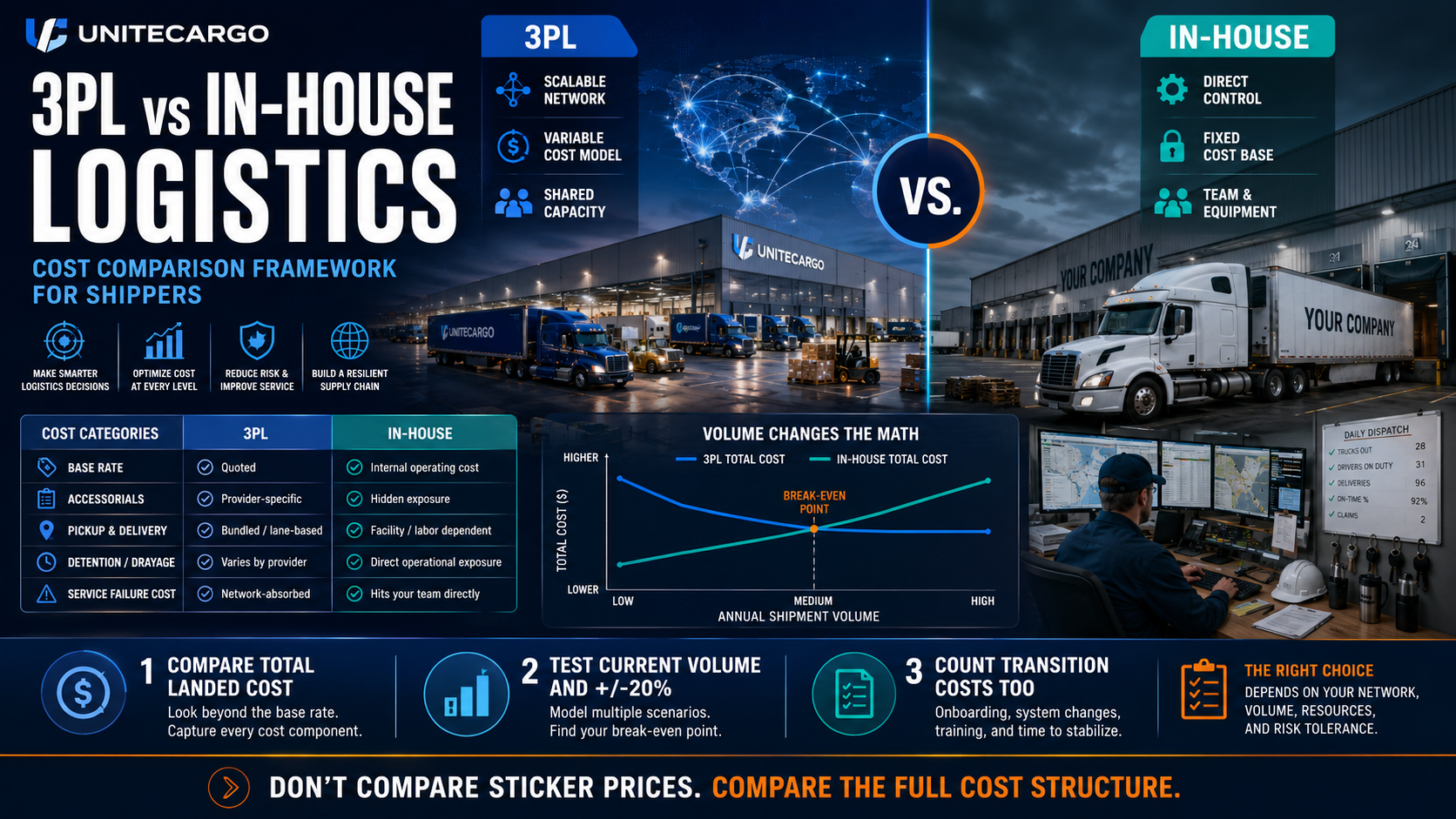
A practical framework for shippers deciding between outsourcing logistics or building internal capability. The answer isn't the same for every operation.
TL;DR
Every shipper eventually hits the wall: is it cheaper to own logistics capability or rent it? The answer isn't in the base rate—it's buried in cost categories most comparison frameworks never name. This framework breaks the decision into its real components so you can stop guessing and start calculating.
Why This Matters Now
Logistics used to be simple. You moved freight, you paid for movement, life went on. That's not the world shippers live in anymore.
In 2025-2026, three shifts have made this decision harder:
1. Accessorial costs have proliferated. Detention, reconsorting, lumr fees, special handling surcharges—these add-ons now represent 15-30% of total landed cost for many shipments, yet they rarely appear in the first quote [2].
2. Capacity pressure has shifted the scale equation. The break point where internal operations become cheaper than outsourcing has moved as carrier capacity tightened and expedite premiums rose.
3. Service level expectations have risen. What passed for "good enough" logistics two years ago now triggers complaints, returns, and customer churn—internal teams face this cost directly while 3PLs can spread it across their network [1].
The shipper who figures this out systematically beats the one guessing.
The Operational Problem
Here's what most shippers do when evaluating 3PL vs. in-house: they get a rate from a provider, compare it to their internal cost per mile (or an estimate), and decide based on which number is lower.
That methodology fails for three reasons no one talks about:
Reason One: you're comparing different things. The 3PL quote includes accessorials you'll likely hit. Your internal number probably doesn't include the opportunity cost of your team doing dispatch instead of revenue work [2].
Reason Two: volume assumptions break the math. Internal logistics carry fixed costs whether you run one shipment or fifty—labor, equipment depreciation, facility overhead, insurance requirements. Those costs don't scale linearly. The 3PL spreads their fixed costs across hundreds of shipments—their per-unit burden is different from yours [3].
Reason Three: failure has a cost you're not counting. When internal capacity fails—your driver calls in sick, your truck breaks down, your dock is backed up—that failure hits your customer's delivery window and your reputation. 3PLs absorb that variance across their network. Their failure costs get amortized; yours hit you directly [6].
The sticker-price comparison answers the wrong question.
What the Evidence Shows
Industry guidance on logistics cost structures converges on a few key points:
Cost Category Breakdown: Total landed cost in logistics breaks into at least five distinct buckets:
- Base transportation rate (the number everyone quotes first)
- Accessorials and accessorial surcharges (detaining, reconsorting, lumr, special handling, dim adjustments)
- Pickup and delivery fees (varies dramatically by location pair)
- Detention or drayage exposure (when the receiving facility can't unload fast enough)
- Service failure costs (missed windows, returns, customer churn)
S2 confirms that "hidden" categories can represent 15-30% of true cost. S4 adds that no two providers price these identically—apples-to-apples comparison requires looking at all buckets.
In-House Cost Reality: Internal logistics operations carry a fixed-cost floor that's easy to undercount:
- Labor (driver hourly rates, dispatcher time)
- Equipment depreciation (truck and trailer lifecycle costs)
- Facility overhead (loading dock space, yard rental)
- Insurance and bonding requirements
S3 emphasizes that these costs "persist whether shipments run or not"—making per-shipment internal cost highly sensitive to volume assumptions.
Scale Economics: The most consistent finding across sources is that scale fundamentally changes the math. S6 summarizes: in-house makes sense when you have enough volume to absorb fixed costs into competitive per-unit terms. Below that threshold, the 3PL advantage grows because they already paid their fixed costs and are selling you marginal usage.
There's no universal break point—it depends on your specific cost profile—but the *category-based comparison methodology* is universally applicable [5].
Where UniteCargo's Perspective Fits
UniteCargo sees this decision from a position most shippers don't: we're looking at it from across hundreds of provider relationships and operational profiles.
What that view teaches us:
The providers who price transparently are easier to compare. When a 3PL quotes all their cost categories clearly, you can benchmark them honestly. The ones who hide accessorials behind "it's complicated" language are telling you something about their pricing discipline [2].
Provider vetting is harder for in-house than outsourcing. If you build internal logistics, you're not just comparing rates—you're hiring drivers, maintaining equipment, and managing compliance. That's a completely different skill set than evaluating an outsourced provider against your requirements.
The framework here works whether you're looking at 3PLs or building internally—what matters most is applying the same comparison discipline to both sides of the ledger [4].
Risks and Counterarguments
Counterargument One: "We tried in-house and it was cheaper."
It might have been—for that specific volume profile, at that specific time. This framework doesn't say one answer is always right. It says the methodology matters. If you compared sticker prices two years ago when volumes were different, the math may not hold anymore [6].
Counterargument Two: "3PLs add no value we can't replicate."
You might be able to. But replicating 3PL capabilities—carrier relationships across modes, geographic coverage, equipment type access, capacity surge handling—requires investments that only make sense if you're running at volume where those investments pay back [1].
Counterargument Three: "We'll just switch providers if it doesn't work."
Transition costs exist in both directions. Moving to a 3PL involves onboarding friction. Moving away from one after you've built processes around their quirks carries its own hidden cost. This framework applies when you're *starting* the evaluation, not mid-committed [2].
Recommended Next Move
Before you commit to either path, build your comparison using these steps:
1. Calculate total landed cost for your current operation (internal or outsourced)—include all five categories from accessorials through service failures
2. Get quotes that break out each category, not just a single number—ask explicitly how providers handle accessorial surcharges
3. Run the math at your current volume, then test it at +20% and -20% — see where each model's economics cross
4. Add transition cost to both sides if you're changing states—if you're internal now, what would moving to 3PL actually cost you in onboarding?
5. Make a decision that can be revisited, because volume changes over time
The right answer isn't universal—but it can be calculated honestly using the same categories for both sides of comparison.
FAQ
Q: What's a realistic percentage of "hidden" costs above the base rate?
A industry sources suggest 15-30% depending on shipment profile, route complexity, and accessorial exposure. High-value shipments with complex handling see higher percentages; straightforward point-A to point-B runs tend toward the lower end [2].
Q: At what volume does in-house typically become more cost-effective than 3PL?
There's no universal number—S6 confirms it varies by operation profile—but a useful heuristic is whether your fixed internal costs, when amortized across your annual shipment count, beat or match provider marginal rates. Run the math at your actual numbers [6].
Q: Can I use this framework for international freight?
The category structure holds, but accessorial profiles differ significantly between domestic and cross-border moves. Rate transparency is typically worse in international lanes—build extra buffer into comparison assumptions there.
References
- Electronic Code of Federal Regulations (eCFR) (Current as of access). 41 CFR Part 102-117 - Federal Transportation Management [Link]
- Federal Motor Carrier Safety Administration (FMCSA) (Current as of access). FMCSA Carrier Regulations Database [Link]
- Amazon Multi-Channel Fulfillment (Current as of access). Amazon 3PL Pricing Guide [Link]
- CSCMP / Third-Party Logistics Study (2025). 2025 Third-Party Logistics Study [Link]
- Electronic Code of Federal Regulations / Federal Motor Carrier Safety Administration (Current as of access). 49 CFR Part 375 Subpart D - Estimating Charges [Link]
- Freightquote by C.H. Robinson (Current as of access). Freightquote Accessorial Definition [Link]