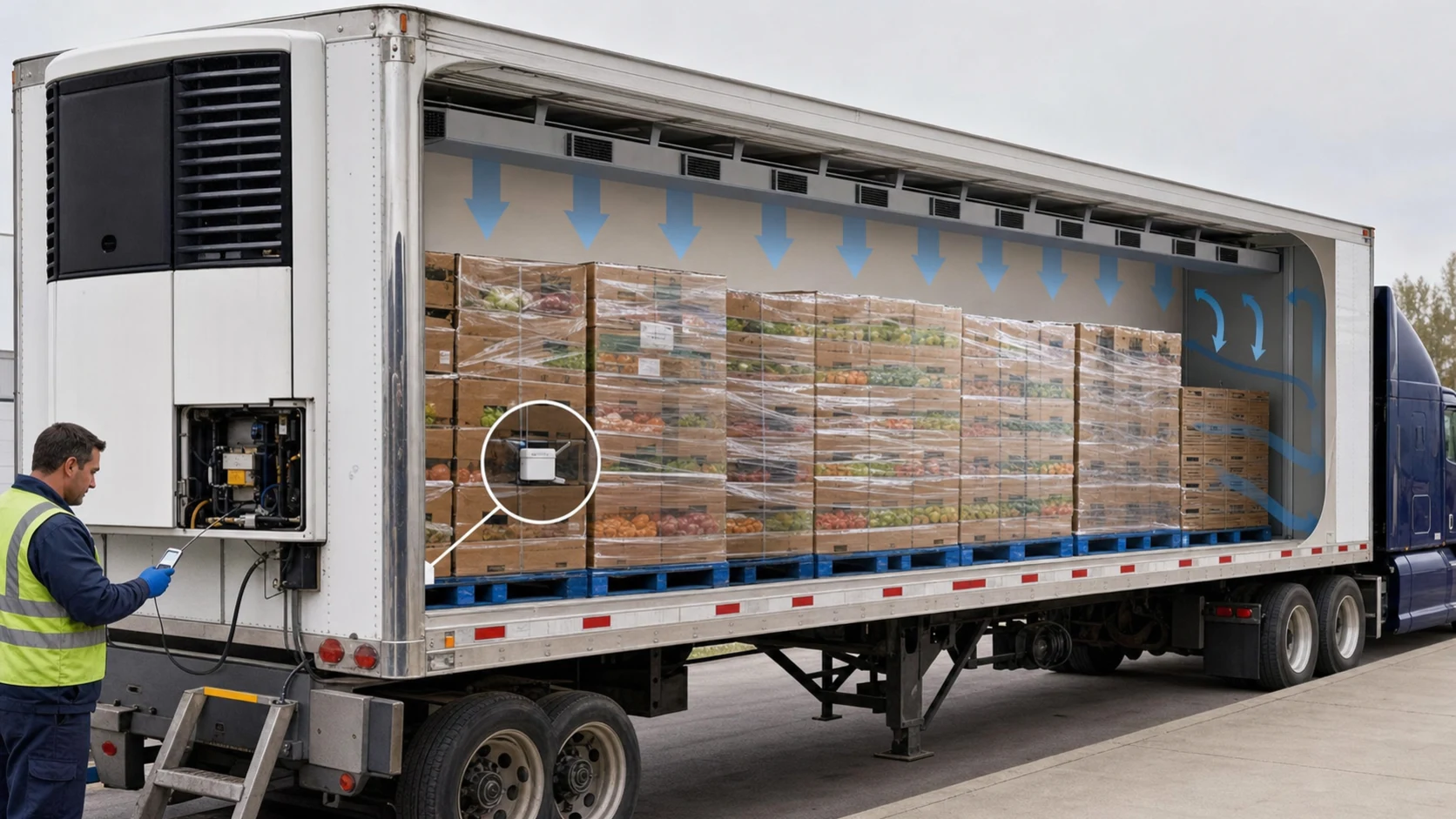
A reefer set point is not a cold-chain plan; reliable temperature-controlled freight starts with a product specification, explicit handoffs, usable evidence, and a disposition process.
Cold-chain failures are often discussed as refrigeration failures. Many are specification failures.
A dispatcher receives “keep frozen” in an email. A carrier is given a trailer set point but not the product's allowable exposure. A loader checks the supply-air display but not whether the product was already warm. A receiver sees an alarm and rejects the load without knowing where the sensor sat, how long the excursion lasted, or whether the product was actually affected.
The trailer may have done exactly what it was told to do. The operating system around it did not.
The practical rule is:
Define the acceptable condition of the product first. Then design the packaging, equipment, monitoring, handoffs, and response process that can maintain—and prove—that condition.
That distinction matters whether the load is frozen food, fresh produce, biologics, chemicals, or another temperature-sensitive product. The acceptable range, evidence standard, and disposition authority are product-specific. “Refrigerated freight” is a mode description, not a complete control plan.
Separate product safety from product quality
An out-of-range reading can signal a safety problem, a quality problem, both, or neither. Those are not interchangeable conclusions.
For food, the shipper's hazard analysis and product knowledge should establish the transportation conditions necessary to prevent the food from becoming unsafe. A narrower commercial specification may also protect texture, appearance, shelf life, or customer requirements. The first can be a regulatory food-safety control; the second may be a contractual quality control.
For pharmaceuticals and vaccines, the approved labeling, manufacturer stability data, and applicable quality system govern the product decision. The CDC's vaccine storage and handling guidance, for example, emphasizes following product information, continuously monitoring appropriate conditions, and treating custody as a shared responsibility. Those vaccine-specific instructions should not be copied onto a food load—or even onto a different pharmaceutical product.
Build the shipment specification with two visible lines:
- Safety or efficacy limit: the condition beyond which the product may not be released without qualified review.
- Commercial operating range: the tighter band used to protect quality and create response time before the safety or efficacy limit is threatened.
This prevents a customer preference from being presented as a universal safety threshold, and it prevents a genuine safety limit from being negotiated away as a service-level issue.
Write the cold-chain freight specification before requesting a rate
A usable cold-chain specification gives operations enough information to plan the load and quality enough information to evaluate an exception. At minimum, it should answer:
- What product and lot is moving?
- What temperature range applies, and what source controls that range?
- Is the product sensitive to heat, freezing, cumulative exposure, humidity, light, shock, or ventilation?
- Must the product be loaded at temperature, or is the transport equipment expected to remove heat?
- Is the set point continuous, start-stop, or otherwise mode-specific?
- Are supply-air, return-air, ambient, surface, pulp, or buffered-product readings required?
- What packaging and thermal protection are qualified for the lane and season?
- Where will monitoring devices be placed, at what interval will they record, and who owns the data?
- Which prior cargoes, odors, residues, allergens, or cleaning methods are unacceptable?
- Who verifies trailer condition and pre-cooling before loading?
- Who may change a set point or operating mode, and how is that authorization recorded?
- What event triggers an immediate call, a hold, a rejection, or a quality review?
- Who has final authority to release or dispose of exposed product?
Do not bury these answers across a purchase order, carrier tariff, SOP, and email chain. Put the shipment-critical version in one lane or product profile, identify its owner, and version-control it.
That specification is also the commercial baseline. Use the freight-pricing architecture to expose trailer type, monitoring, washout, dwell, fuel, recovery, and other requirements as priced assumptions rather than leaving them implicit.
Map responsibility to the physical handoff
For covered human and animal food shipments by motor or rail vehicle, the FDA's Sanitary Transportation rule assigns responsibilities across shippers, loaders, carriers, and receivers. The rule is not a generic requirement that “the carrier owns temperature.”
The FDA's explanation of the final rule makes the structure clearer:
| Party | Operating responsibility to make explicit |
|---|---|
| Shipper | Determine the sanitary and, where applicable, temperature conditions needed for safe transport; communicate specifications; maintain required procedures and records |
| Loader | Check the relevant condition of the equipment before loading; for food requiring temperature control for safety, verify that the refrigerated compartment is adequately prepared, including pre-cooling when necessary |
| Carrier | Perform the sanitary-condition functions assigned in the written shipper-carrier agreement; train covered personnel when the rule and agreement make the carrier responsible |
| Receiver | Assess whether food requiring temperature control for safety was subjected to significant temperature abuse when indicated by the circumstances |
The exact regulatory language, scope, exceptions, and record requirements are in 21 CFR Part 1, Subpart O. FDA also notes that the rule does not cover transportation by ship or air and contains exemptions and waivers. Do not assume that a shipment falls inside or outside the rule from the commodity name alone.
The operating lesson reaches beyond food: responsibility should follow the function a party can actually perform, and the contract should name that function. “Maintain cold chain” is too vague to dispatch, audit, or defend.
Treat product, packaging, and equipment as one thermal system
A refrigeration unit primarily maintains the condition of a properly prepared load. It should not be treated as unlimited capacity to pull down warm product after loading.
Before release to the dock, confirm:
Product condition
- Product is within the approved loading range.
- Pallet configuration allows the intended airflow.
- Packaging is dry, intact, and qualified for the expected lane duration.
- Lot and expiration data match the shipment record.
Equipment condition
- The equipment type and capacity match the product, load geometry, ambient conditions, and trip.
- The box, doors, seals, drains, bulkheads, and air chutes are intact.
- The compartment is clean, odor-free, and suitable for the intended cargo.
- Required pre-trip inspection or equipment diagnostic has passed.
- Fuel or energy is sufficient for the trip plus an agreed contingency.
- The compartment is pre-cooled if the specification requires it.
Loading condition
- Airflow paths are not blocked.
- Product is not placed against known hot or cold spots unless the packaging plan accounts for them.
- Door-open time is controlled and recorded when material.
- Mixed products are compatible in temperature, sanitation, odor, and airflow needs.
- The seal number, device IDs, set point, operating mode, and departure time are captured.
A green light on the refrigeration controller verifies only part of this system.
Monitor the product risk—not just the machine
Temperature evidence is useful only when the team knows what was measured.
A trailer's supply-air sensor helps control the refrigeration unit. It does not necessarily represent product temperature. A loose logger near a door may capture loading heat and every door opening. A probe buried in a thermally buffered package may lag ambient changes but better approximate the product. Neither is inherently “the truth”; each answers a different question.
The monitoring plan should document:
- device make, identifier, accuracy, calibration status, and time synchronization;
- probe or logger placement;
- recording interval;
- alarm thresholds and alarm delay;
- whether the measurement represents air, surface, pulp, or a buffered medium;
- who receives live alerts;
- who downloads the record at destination;
- how raw data and audit history are retained.
This is measurement control, not sensor procurement. NIST's work on the calibration stability of cold-chain data loggers is a useful reminder that device performance, verification, and traceability matter alongside placement.
For high-consequence product, qualify the lane. Seasonal profiles, loading patterns, door events, dwell points, and equipment behavior reveal risks that a generic “continuous monitoring” requirement will not.
Build exception handling before the first alarm
The worst time to decide who owns an excursion is while a driver waits at a receiving dock.
Use a written response path:
- Protect the product. Restore the specified condition when it is safe to do so. Do not make an unapproved set-point change that creates a second problem.
- Notify the named contacts. Operations, shipper quality, receiver, and carrier contacts should know which events require immediate escalation.
- Preserve evidence. Retain raw logger data, refrigeration downloads, telematics, seal history, photos, bills of lading, interchange records, arrival and departure times, and communications.
- Segregate the decision. Place affected product on hold or quarantine when required. Do not release it merely because the temperature has returned to range.
- Assess actual exposure. Qualified product owners evaluate duration, magnitude, location, product temperature, packaging, stability information, and any safety implications.
- Record disposition. Release, recondition, divert, reject, or destroy under the authority defined by the product's quality system.
- Find the control failure. “Temperature excursion” is an event description, not a root cause.
FDA states that when a covered party becomes aware of a condition that may render food unsafe, the food should not be sold or distributed until a qualified determination of safety is made. The agency's small-entity compliance guide is useful for understanding how the rule's roles and written agreements operate.
When cargo condition becomes disputed, preserve the same evidence needed for a disciplined freight-claims process.
Vet the carrier against the operating plan
“Reefer capable” says almost nothing about control maturity. During motor-carrier vetting, ask for evidence that matches your product and lane:
- Which equipment configurations will actually cover the freight?
- How are refrigeration alarms monitored after hours?
- Who can authorize a set-point change?
- What happens when a unit fails in a low-capacity market?
- Are team members trained on the product-specific SOP and, where applicable, FDA sanitary-transportation duties?
- How are washouts, prior cargo, sanitation, and trailer suitability documented?
- Can the carrier provide original refrigeration and telematics data rather than a screenshot?
- How are sensors and control devices calibrated or verified?
- What is the escalation path for missed appointments, extended dwell, rejected loads, and cross-docks?
- Which subcontractors may touch the freight, and are they held to the same requirements?
For food movements covered by the Sanitary Transportation rule, FDA provides carrier training resources. Training does not substitute for a workable lane plan, but a lane plan assigned to untrained people is equally weak.
Measure control quality, not just on-time delivery
On-time delivery can conceal a poorly controlled load. A useful cold-chain scorecard combines service, product condition, and response quality:
- loads released without exception;
- excursions per 100 shipments, segmented by cause;
- loads tendered with complete specifications;
- equipment pre-cool and pre-trip compliance;
- logger activation and data-recovery rate;
- alarm acknowledgment and escalation time;
- receiver dwell and door-open exposure;
- loads placed on hold awaiting disposition;
- disposition cycle time;
- rejected or destroyed units and recoverable value;
- repeat corrective actions by lane, facility, carrier, and equipment type.
Do not reward a team for suppressing alarms or avoiding holds. Measure whether the controls identify risk early and resolve it with defensible evidence.
A compact cold-chain release gate
Before a temperature-controlled load leaves, the shipper, loader, and carrier should be able to answer yes to these questions:
- Is the current product specification attached to the shipment?
- Is the product within its approved loading condition?
- Is the equipment suitable, clean, inspected, and prepared?
- Are set point, mode, and change authority documented?
- Are monitors active, identified, placed correctly, and time-synchronized?
- Are seal and chain-of-custody fields complete?
- Are exception contacts available for the entire transit window?
- Does the receiver know the arrival, evidence, and disposition process?
If the answer to one of those questions is no, a lower linehaul rate does not make the load ready.
Operating takeaway
Cold-chain performance is not “did the reefer run?” It is whether the parties maintained the product's defined condition, detected meaningful deviation, preserved usable evidence, and made disposition decisions under a controlled process.
Start with the product. Assign each handoff in writing. Make the measurement plan explicit. Practice the exception path. Then buy the capacity that can execute it.
Place the lane within the broader operator's map of how freight moves across America, then use UniteCargo's temperature-controlled provider listings to identify candidates for the product- and lane-specific vetting process.
This article provides operational education, not legal, food-safety, medical, or regulatory advice. Product owners should confirm current requirements and product-specific conditions with qualified quality, safety, and legal professionals.
Sources and further reading
- FDA: FSMA Final Rule on Sanitary Transportation of Human and Animal Food
- Electronic Code of Federal Regulations: 21 CFR Part 1, Subpart O
- FDA: Small Entity Compliance Guide for Sanitary Transportation
- FDA: Carrier Training for the Sanitary Transportation Rule
- CDC: Vaccine Storage and Handling
- CDC: Vaccine Storage and Handling Toolkit
- NIST: Calibration Stability of Data Loggers Used for Vaccine Temperature Monitoring