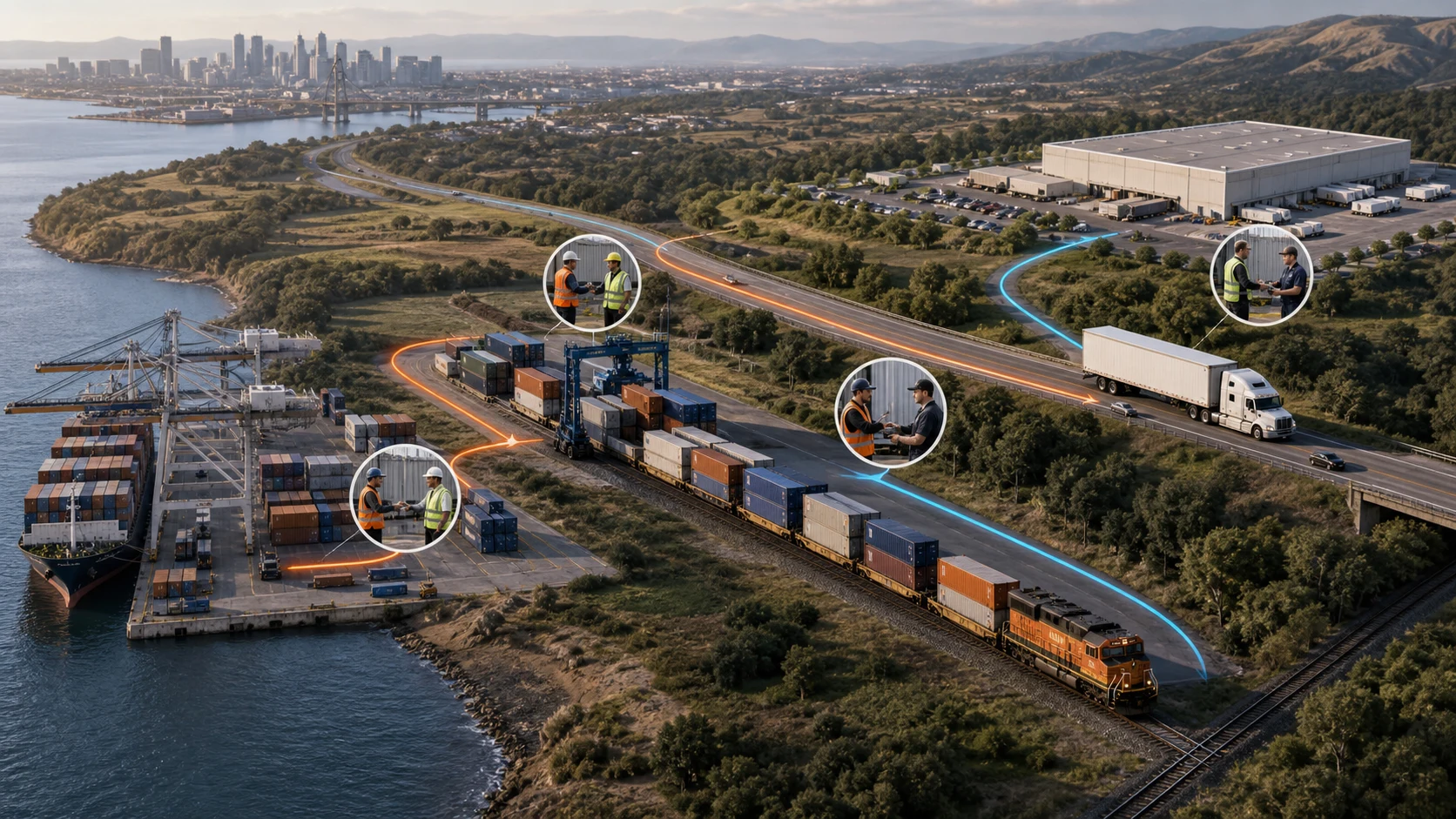
A practical map of the modes, nodes, documents, handoffs, and clocks that determine whether U.S. freight moves cleanly or becomes an exception.
Freight does not move across the United States as one continuous service. It moves through a chain of releases, pickups, terminal events, linehaul legs, inspections, transfers, and deliveries. The physical cargo may stay inside the same container, but custody, commercial control, equipment responsibility, and regulatory authority can still change several times.
That distinction matters. A shipment can be “on schedule” in a transportation-management system while the container is unavailable, the delivery appointment is missing, the chassis is defective, or the receiving dock has no labor. The cost of a weak handoff is rarely confined to one late load. It can become storage, detention, a production shortage, a rejected delivery, a claim with poor evidence, or a second truck dispatched to do the first truck's job.
The short answer: manage freight as a chain of controlled handoffs
The most useful answer to how freight moves in the United States is not a list of modes. It is a control model:
At every handoff, identify the freight and equipment, the party with custody, the party authorized to give instructions, the document that proves the event, the clock that is running, and the condition required for the next party to act.
The Freight Analysis Framework maintained by FHWA and the Bureau of Transportation Statistics maps U.S. commodity flows by origin, destination, commodity, and mode. That national view is useful for network design. An operator needs a second map underneath it: the transaction-level path that shows where responsibility and information change hands.
How freight moves in the United States: modes connected by nodes
Each mode is good at a different transport problem. Each node introduces a transfer, queue, capacity constraint, or release condition.
| Movement | What it is usually best at | Common nodes | Control point that operators miss |
|---|---|---|---|
| Full truckload | Door-to-door movement with dedicated trailer capacity and limited handling | Shipper dock, drop yard, receiver | “Exclusive trailer” does not remove appointment, weight, securement, or receiving constraints |
| LTL | Combining smaller shipments through a scheduled terminal network | Pickup terminal, breakbulk hub, delivery terminal | Freight description, dimensions, packaging, accessorials, and repeated handling affect cost and condition |
| Rail intermodal | Repeatable long-haul corridors where rail linehaul can absorb the dray and terminal work | Origin rail ramp, destination ramp, container yard | The rate is not door-to-door unless drayage, lifts, equipment use, and exception charges are included |
| Rail carload | High-volume bulk, industrial, agricultural, or specialized freight with rail access | Plant siding, classification yard, interchange | First- and last-mile track access and switching performance can control the entire cycle |
| Ocean and inland water | International containerized freight and high-volume bulk or project cargo | Port, marine terminal, container freight station, inland port | Vessel discharge is not the same as cargo availability or customs release |
| Air cargo | High-value, urgent, or service-critical freight that can support airport handling and linehaul cost | Airport cargo terminal, forwarder facility, customs inspection point | Cutoffs, screening, dimensional weight, and recovery after a missed flight can erase the theoretical speed |
| Pipeline | Continuous movement of suitable liquids and gases | Gathering system, terminal, storage facility | It is a specialized network, not a substitute for discrete packaged freight |
The public infrastructure behind those movements is extensive, but a lane succeeds or fails locally. The National Highway Freight Network identifies highway segments and connectors that matter to freight at a policy level. The Federal Railroad Administration's freight rail overview explains the privately owned rail network and its role in long-distance and intermodal movement. The Maritime Administration's port data program covers vessel calls, cargo volumes, terminal performance, and intermodal connectivity.
None of those networks delivers freight by itself. The operating product is the connection between them.
A shipment's seven operating stages
The stages below apply broadly to domestic and international freight. The parties and records change by mode, but the control questions remain stable.
1. Order release and transport design
The commercial order creates a transport requirement, not a transport plan. Before tender, the shipper or its logistics provider has to convert the order into a shipment profile:
- actual origin and destination, including dock hours and access limits;
- commodity, packaging, piece count, gross weight, dimensions, and stackability;
- temperature, hazardous-material, high-value, food, security, or handling requirements;
- requested pickup and delivery windows;
- equipment and loading method;
- trade, customs, or border requirements;
- financial consequence of early, late, damaged, or partial delivery.
This is where the mode decision belongs. If the profile is wrong, a competitive rate only prices the wrong movement more efficiently.
2. Tender and acceptance
A tender should establish more than “carrier accepted.” It should bind a named provider, equipment type, origin and destination windows, reference numbers, agreed price basis, accessorial rules, and escalation path.
Acceptance also needs an owner. A broker may arrange the carrier while the shipper still controls loading. A forwarder may issue a through document and purchase underlying transportation. A 3PL label by itself says little about legal role or custody. The guide to brokers, 3PLs, and freight forwarders separates those roles.
3. Origin readiness and pickup
“Ready” has to mean physically and administratively ready:
- freight is packed, marked, counted, and accessible;
- weight and dimensions match the tender;
- shipping instructions and reference numbers are available;
- the correct dock, labor, loading equipment, and appointment are confirmed;
- the vehicle or intermodal equipment is suitable;
- any required seals, temperature settings, permits, or security controls are known.
The carrier's arrival does not cure a shipper-side readiness failure. Nor does a shipper's correct paperwork cure defective equipment. The pickup event needs a contemporaneous record of count, apparent condition, seal, time, and exceptions.
For covered for-hire motor carriage, 49 CFR Part 373 specifies core information for receipts and bills of lading, including consignor, consignee, origin, destination, package count, freight description, and weight or measurement when relevant to rating. A commercial bill of lading may do additional work under the parties' contract, but operators should not assume one document has identical legal effect across every mode and transaction.
4. Consolidation and linehaul
The freight now enters the provider's operating network.
- A truckload may run directly, relay between drivers, or sit in a drop yard.
- An LTL shipment may pass through pickup, breakbulk, and delivery terminals.
- An intermodal container is drayed to a ramp, lifted to rail, linehauled, grounded, and drayed again.
- An air shipment may be consolidated by a forwarder, screened, built into a unit load, and transferred to an airline.
- An ocean import moves under vessel and terminal plans before a truck or rail provider can recover it.
The important question is not merely “where is it?” It is “what event has occurred, and what event is next?” Departed origin, arrived terminal, unloaded, available, released, mounted, out-gated, and delivered are not synonyms.
5. Node release and transfer
Nodes are where independent operating systems meet. That is why they generate so many exceptions.
A transfer may require several conditions at once: physical arrival, carrier release, customs or agency release, fee payment, valid appointment, driver credentials, equipment availability, and a receiving location willing to accept the unit. CBP describes the Automated Commercial Environment as the U.S. single-window platform for manifest, cargo-release, post-release, export, and partner-government-agency data. A customs release is still only one release gate; terminal and commercial holds can remain.
At an intermodal interchange, the equipment interchange receipt records the transfer and apparent equipment condition. At a warehouse, a signed inbound tally or warehouse receipt may prove what was received. At a cross-dock, the count out of the inbound unit and count into the outbound unit should reconcile. If the records do not connect, the eventual shortage investigation becomes guesswork.
6. Final delivery
Delivery is a capacity event at the receiver, not simply the end of linehaul. The carrier needs a valid location, appointment, receiving reference, equipment-access plan, and a decision path for refused, damaged, over, short, or late freight.
A useful proof of delivery records:
- arrival, check-in, dock, unload, and release times where relevant;
- delivered piece or handling-unit count;
- seal condition and number, if used;
- visible damage, shortage, overage, or refusal notation;
- recipient name or authenticated electronic acceptance;
- photos, temperature records, or other evidence required by the shipment profile.
“Signed clean” is not a substitute for an actual receiving process. Conversely, a delivery notation alone may not constitute a complete cargo claim. The freight-claims operating guide addresses evidence, notice, mitigation, and claim filing separately.
7. Financial and exception closeout
The physical move and the financial move close on different clocks. The freight bill should be audited against the tender, rate confirmation, tariff or contract, actual shipment characteristics, accessorial evidence, and proof of delivery. Open exceptions should remain tied to the shipment record until resolved.
The owner of freight audit should not have to reconstruct operations from an invoice. Detention needs timestamps. Reclassification needs measured dimensions, weight, and the governing rating rule. A redelivery charge needs the first delivery attempt and failure reason. A chassis or equipment-use charge needs interchange events and return evidence.
For a deeper view of the price architecture, use the guide to how freight rates are calculated.
Four kinds of control change at a handoff
Operators get into trouble when they use “responsible” without saying responsible for what.
- Physical custody: Who possesses the cargo or equipment now?
- Instructional control: Who may reroute, hold, release, or change delivery?
- Commercial responsibility: Who contracted for the service or owes a charge under the applicable agreement?
- Regulatory authority: Which agency or rule controls release, safety, admissibility, or handling?
Those roles can sit with different parties. A dray carrier can have physical custody of a container without being the importer of record. A broker can transmit instructions without taking cargo into custody. A marine terminal can control gate access while an ocean carrier controls commercial release. A consignee can be ready to receive while CBP or another government agency maintains a hold.
Every operating escalation should therefore name the blocked condition and the party capable of clearing it. “Port delay” is not actionable. “Container discharged, customs released, ocean-freight hold open; importer must obtain carrier release before the last free day” is.
The documents that make the physical chain auditable
No universal document set fits every move, but these records form a useful control spine:
| Record | What it should prove | Common failure |
|---|---|---|
| Shipment instructions or tender | What service was requested and under which references and terms | Critical handling or appointment condition lives only in an email |
| Bill of lading, waybill, or carrier receipt | Freight identity, parties, origin, destination, count, description, and shipment acceptance | Document data does not match the freight actually tendered |
| Terminal, PRO, container, or air-waybill event | Network milestone tied to a unique identifier | Status label is treated as proof of availability |
| Manifest and release messages | Regulatory filing and release status | “Filed” is read as “released”; one agency's release masks another hold |
| Equipment interchange receipt | Time, place, unit identity, transfer, and apparent equipment condition | No photos or exception notation at out-gate or return |
| Delivery record | What, when, where, and in what apparent condition the receiver accepted | Illegible signer, no count, or no timestamps |
| Freight bill and accessorial support | Why the amount is due under a rate, contract, tariff, or service event | Invoice code without the operational evidence behind it |
The identifier strategy matters as much as the documents. Purchase order, load number, PRO, bill of lading, container number, booking, seal, trailer, rail unit, and invoice should be cross-referenced rather than stored as isolated keys.
Choose a mode by its entire operating path
Rate and nominal transit time are inputs, not decisions. A sound mode choice tests:
- Shipment geometry: weight, cube, length, stackability, loading method, and equipment fit;
- Product tolerance: handling, vibration, temperature, contamination, theft, and delay sensitivity;
- Corridor reality: origin and destination access, ramp or terminal proximity, border and urban constraints;
- Time requirement: pickup flexibility, delivery window, variability tolerance, and recovery options;
- Node burden: number of transfers, appointments, cutoffs, releases, and equipment dependencies;
- Inventory consequence: working capital, safety stock, production exposure, and customer penalty;
- Exception economics: rework, storage, redelivery, expedite, claims, and management time;
- Provider fit: authority, operating model, lane density, equipment, communications, and evidence quality.
That is why an LTL quote should be compared with FTL and partial truckload on total risk, and an intermodal proposal should be tested through a corridor-level intermodal-versus-truckload framework.
A pre-tender control card
Before releasing a shipment, the operating owner should be able to answer:
- What exactly is moving, in what handling units, at what verified weight and dimensions?
- Which service and equipment have been purchased?
- Who is the contractual counterparty, actual carrier, and contact for exceptions?
- What are the pickup, node, and delivery windows?
- Which releases, credentials, permits, or appointments must exist?
- Which party owns loading, securement, count, seal, temperature, and unloading?
- Which clocks can create a charge?
- Which events and documents constitute pickup, transfer, availability, delivery, and return?
- What is the recovery plan if the primary movement fails?
- Who can authorize additional cost?
If those answers are unavailable, the shipment is not controlled; it is merely booked.
Follow the decision into the operating guide
This map is the cluster's starting point. Use the next guide that matches the decision in front of you:
- Network and mode: compare FTL, LTL, and partial truckload, evaluate intermodal against truckload, or control port and rail drayage.
- Counterparty and execution: separate brokers, 3PLs, and forwarders, vet a motor carrier, select a warehouse or 3PL, or build an executable routing guide.
- Cost and failure control: understand freight pricing, separate detention, demurrage, and per diem, preserve a freight claim, or strengthen fraud and cargo-theft controls.
- Specialized operations: design cold-chain control around the product, map hazmat responsibilities, build a clean U.S. import handoff, or model last-mile delivery economics.
- Documents and commercial controls: distinguish the bill of lading, rate confirmation, and freight invoice, build defensible proof of delivery, control freight audit and payment, or set the order of precedence among contracts and shipment documents.
- Facility and capacity execution: design dock appointment control, choose between live loading and drop trailers, distinguish cross-docking from transloading, or test an inbound freight consolidation program.
- Equipment and additional service decisions: plan flatbed loading and securement, control oversize and overweight freight, decide when expedited freight is justified, or compare parcel and LTL networks.
- Performance and continuity: build a defensible carrier performance scorecard, run a freight RFP that produces usable capacity, turn visibility data into exception decisions, or prepare a trigger-based logistics contingency plan.
- Warehouse and inventory execution: control warehouse receiving, improve inventory accuracy, redesign warehouse slotting, or govern the reverse-logistics process.
- Packaging and cargo integrity: engineer freight packaging and palletization, create an executable trailer load plan, investigate freight damage by mechanism, or make cargo-seal events auditable.
- Import and trade controls: build the ISF 10+2 data handoff, compare a bonded warehouse with a foreign-trade zone, choose continuous or single-transaction customs-bond coverage, or translate Incoterms into an operating handoff.
- Capacity strategy and controlled freight: choose spot or contract freight, compare private, dedicated, and for-hire control, govern food-grade bulk transportation, or secure a high-value freight lane.
Continue through the full-year operator library
The core guide explains the system. The rest of the year-long library follows the work into the operating disciplines and cargo environments where decisions become specific.
Motor-carrier execution and compliance
- FMCSA Operating Authority vs. USDOT Number: Know Which Registration Controls the Move
- Hours-of-Service Trip Planning: Build a Legal Plan That Can Survive the Dock
- ELD Compliance and Exception Management: Treat the Record as Evidence, Not Dispatch Capacity
- Driver Qualification Files: Build a Living Qualification Control, Not a Hiring Folder
- FMCSA Clearinghouse Compliance: Control Queries, Consent, and Prohibited Status
- IRP and IFTA Compliance: Keep Vehicle Registration and Fuel Tax Evidence Aligned
- Roadside Inspections and Out-of-Service Orders: Turn Findings into Fleet Controls
- DOT-Recordable Crash Response: Protect People, Evidence, and Compliance Clocks
Fleet, dispatch, and equipment operations
- Truck Dispatch Planning: Match the Load to a Real Driver, Tractor, Trailer, and Clock
- Truck Preventive Maintenance Programs: Control Due Work by Risk and Utilization
- DVIR and Defect Management: Close the Loop from Driver Observation to Safe Release
- Commercial Truck Tire Management: Control Pressure, Condition, Position, and Removal
- Trailer Fleet Management: Size, Position, Inspect, and Recover the Pool
- Freight Trailer Types: Match Equipment to Cargo, Facility, and Unloading Method
Rail and intermodal operations
- Domestic Intermodal Shipping: Engineer the Rail and Dray Handoffs
- Rail vs. Truck Freight: Compare Door-to-Door Cost, Variability, and Inventory
- Rail Demurrage and Storage: Control Cars, Containers, Notices, and Disputes
- Rail Service Metrics: Measure the Car Cycle, Not Just Estimated Arrival
- Railcar Fleet Management: Size the Fleet Around the Complete Car Cycle
- Rail Transloading: Design the Transfer Around Product, Throughput, and Custody
- Intermodal Container Weight Control: Prevent Gross, Axle, and Data Failures
- Rail Freight Claims: Preserve the Load, Prove the Claim, Protect the Calendar
- Rail Shipping Instructions and Waybills: Make the Data Executable
- Rail Embargoes and Service Interruptions: An Operator’s Recovery Playbook
Ports and ocean freight
- Ocean Freight Shipping Process: From Booking to Empty Return
- FCL vs. LCL Shipping: A Door-to-Door Decision Guide
- FMC Demurrage and Detention Invoices: A Current Audit Guide
- Ocean Cargo Insurance: How to Match Coverage to the Shipment
- Ocean Bill of Lading: Choose, Review, and Release the Right Document
- SOLAS Verified Gross Mass: A Container VGM Control Guide
- Ocean Service Contracts and NVOCC Rates: Make the Deal Bookable
- Port Terminal Container Pickup: Build a Dispatch-Ready Release Stack
- U.S. Export Documentation: Build One Controlled Shipment Record
Air cargo operations
- Air Freight Shipping Process: From Booking to Cargo Recovery
- Air Freight Chargeable Weight: Audit Actual Weight, Volume Weight, and Rate Breaks
- TSA Known Shipper and Indirect Air Carrier Controls: A Public-Rule Operations Guide
- Air Cargo ULD Planning: Compatibility, Contour, Restraint, and Handoff
- Dangerous Goods by Air: Build Compliance from Classification to Acceptance
Yards, docks, and domestic handoffs
- Yard Management Process: Control Every Trailer from Gate Arrival to Exit
- Dock Door Assignment: Match Each Trailer to a Safe, Ready Work Cell
- Yard Spotter Operations: Dispatch, Couple, Move, and Confirm Every Trailer
- Trailer Yard Safety: Separate People, Vehicles, Trailers, and Dock Work
- Facility Carrier Instructions: Write a Site Guide Drivers Can Execute
- Freight Gatehouse Operations: Verify Access and Custody Without Gridlock
- Domestic Freight Handoffs: A Transfer-of-Custody Standard for U.S. Networks
Network planning, inventory, and logistics economics
- Logistics Network Design: Turn Service Promises into Facility, Inventory, and Flow Decisions
- Distribution Center Location Analysis: Screen Markets Before Committing Capital
- Multi-Echelon Inventory Positioning: Put the Buffer Where It Protects Service
- Freight Demand Forecasting: Convert the Commercial Plan into Shippable Volume
- Transportation Capacity Planning: Cover the Base, Peak, and Failure Case
- Logistics in S&OP: Make Capacity, Inventory, and Service Tradeoffs Decision-Ready
- Logistics Budget Planning: Build a Volume, Rate, Mix, and Service Bridge
- Total Landed Cost Analysis: Compare Supply Options on the Cost That Reaches the Customer
- Logistics Cost-to-Serve: Find the Customer and Order Behaviors Driving Margin
- Strategic Transportation Sourcing: Build a Capacity Portfolio, Not a Rate Event
Transportation procurement, commercial control, and finance
- Freight Procurement Bid Optimization: Constrain the Award Before Trusting the Savings
- Transportation Mini-Bids: Reprice Changed Freight Without Destabilizing the Network
- Carrier Relationship Management: Turn QBRs into Joint Operating Control
- Logistics Service-Level Agreements: Define the Clock, Evidence, and Remedy
- Freight Invoice Approval Controls: Release Payment Only from Matched Evidence
- Accessorial Spend Governance: Prevent the Event Before Negotiating the Charge
- Freight Accrual Accounting: Estimate Incurred Cost Without Paying It Twice
- Fuel Surcharge Program Design: Make the Index, Peg, Math, and Effective Week Auditable
Logistics systems, integration, data, and control towers
- Transportation Management System Selection: Buy the Decision Workflow, Not the Demo
- TMS Implementation: Prove the Shipment Lifecycle Before Scaling Volume
- Warehouse Management System Selection: Test Inventory Truth Under Real Exceptions
- WMS Implementation: Reconcile Every Unit Before Releasing Customer Orders
- TMS-WMS Integration: Make Order, Shipment, Inventory, and Dock Events Reconcile
- EDI vs. API for Freight Integration: Choose the Operating Contract Before the Transport
- Transportation Master Data Management: Control the Fields That Make Freight Executable
- Shipment Visibility Data Governance: Make Every Milestone Fit a Decision
- Logistics Control Tower Operating Model: Give Exceptions an Owner and Decision Clock
Performance measurement and operating governance
- Transportation KPI Dashboard: Build Measures That Trigger Decisions
- OTIF Measurement: Define On Time and In Full Before Ranking Performance
- Perfect-Order Measurement: Test the Whole Customer Order Without Hiding the Failure
- Logistics Root-Cause and Corrective-Action System: Turn Failures into Verified Process Change
- Supplier Routing Compliance: Make Inbound Instructions Executable and Exceptions Traceable
- Customer Delivery-Promise Design: Commit Only What the Network Can Execute
- Supply-Chain Collaboration: Align Data, Decisions, and Cadence Across the Network
- In-Transit Inventory Governance: Control Ownership, Quantity, Status, and Arrival
- Logistics Outsourcing Governance: Retain Control While Another Company Runs the Work
- 3PL vs. 4PL vs. Managed Transportation: Choose the Operating Model, Not the Label
- Carrier Onboarding and Offboarding: Control the Provider Lifecycle Beyond Vetting
- Logistics SOP and Policy Governance: Keep Standard Work Current, Usable, and Controlled
Continuity, emissions, sustainability, and resilience
- Transportation Data Retention and Audit Readiness: Preserve the Record You May Need to Prove
- Freight Cybersecurity and Ransomware Continuity: Keep Cargo Controlled When Systems Fail
- Transportation Emissions Accounting: Build a Freight Inventory That Survives Reconciliation
- Freight Sustainability Program Design: Turn Environmental Goals Into Operating Decisions
- Modal-Shift Program Governance: Move Freight by Rail, Water, Truck, or Air Without Losing Control
- Logistics Resilience Stress Testing: Prove the Network Can Absorb and Recover From Disruption
North American border and export handoffs
- Canada–U.S. Cross-Border Trucking: Build a Shipment That Clears Without Losing Custody
- Mexico–U.S. Cross-Border Freight: Control the Border, Transfer, and Final-Mile Handoffs
- Schedule B vs. HTS vs. ECCN: Keep Three Classification Decisions Separate
- Export Compliance Screening: Resolve Parties, End Use, Destination, and Product Before Release
- Routed Export Transactions: Keep USPPI, FPPI, Agent, and Filing Duties Explicit
- ATA Carnet and Temporary Export Logistics: Protect the Return Obligation
Automotive, aerospace, and defense logistics
- Automotive Inbound Logistics: Protect the Production Schedule Without Hiding Variability
- Automotive Service-Parts Logistics: Design for Vehicle-Off-Road Urgency and Returns
- Aerospace Parts Logistics: Preserve Traceability, Condition, and Release Authority
- Defense Freight Logistics: Separate Transport Execution from Export, Security, and Contract Controls
Life-science and chemical logistics
- Pharmaceutical Cold-Chain Logistics: Qualify the Lane, Not Just the Packaging
- Medical-Device Logistics: Protect Configuration, Sterile Barrier, and Field Traceability
- Chemical Freight Logistics: Align Product Classification, Workplace Information, and Transport Execution
- Bulk Chemical Tanker Logistics: Control Compatibility, Prior Cargo, Loading, and Heel
Energy and industrial project logistics
- Oilfield Equipment Logistics: Plan the Site, Timing, and Backhaul as One Job
- Renewable-Energy Project Cargo: Sequence Components Around Civil and Electrical Readiness
- Utility and Grid Equipment Logistics: Protect Critical Spares and Outage Windows
Agriculture, food, and beverage logistics
- Grain Transportation Logistics: Control Grade, Moisture, Identity, and Conveyance Capacity
- Fresh-Produce Logistics: Manage Harvest Variability, Pre-Cooling, Transit, and Receiver Acceptance
- Live-Plant and Nursery Freight: Protect Plant Health, Moisture, Airflow, and Inspection Eligibility
- Beverage Distribution Logistics: Control Date Code, Package Integrity, Temperature, and Returns
- Beer, Wine, and Spirits Logistics: Separate Alcohol Compliance from Physical Distribution
- Grocery and Foodservice Distribution: Build the Route Around Product, Stop, and Receiving Reality
Retail, e-commerce, and consumer logistics
- Retail Peak-Season Inbound Logistics: Protect Appointments, Allocation, and Recovery Capacity
- E-Commerce Returns Logistics: Decide Refund, Inspection, and Disposition as One Flow
Construction, equipment, and project logistics
- Construction-Materials Logistics: Match Delivery Promises to Jobsite Readiness
- Precast-Concrete Logistics: Integrate Casting Release, Supports, Route, and Erection Sequence
- Heavy-Equipment Transport: Verify the Actual Machine Configuration Before Quoting
- Crane and Rigging Project Logistics: Make the Lift Plan Drive the Freight Plan
Electronics, batteries, and fragile technical freight
- Electronics Logistics: Control Serial Identity, Static, Moisture, Shock, and Theft Exposure
- Semiconductor Logistics: Protect Wafer, Device, and Tool Integrity Across High-Consequence Handoffs
- Lithium-Battery Freight: Classify the Cell, Battery, Equipment, and Condition Before Mode Selection
- Solar-Panel Logistics: Reduce Microcrack, Glass, Moisture, and Project-Sequence Risk
Recycling, waste, and circular-material logistics
- Recycling Logistics: Make Material Acceptance and Downstream Evidence Part of the Freight Order
- Scrap-Metal Logistics: Control Grade, Radiation Screening, Weight, and Load Containment
- Waste Transportation: Determine the Waste Stream Before Selecting the Carrier
Trade-show, event, and temporary-project logistics
- Trade-Show Freight Logistics: Work Backward from the Target-Time Delivery
- Event-Production Logistics: Sequence Staging, Power, Audio, Video, and Returns
Specialist finished-goods logistics
- Fine-Art Logistics: Let the Conservator’s Object Protocol Control the Shipment
- Furniture Logistics: Reduce Handling Damage Before It Becomes a Last-Mile Claim
- Apparel and Textile Logistics: Control SKU Proliferation, Carton Compliance, and Seasonal Clocks
- Paper and Forest-Product Logistics: Control Moisture, Clamp Pressure, Weight, and Roll Movement
- Architectural-Glass Logistics: Control Rack, Orientation, Edge Protection, and Site Unloading
- Tire Logistics: Plan Around Cube, Stability, Traceability, and Scrap-Tire Returns
Humanitarian and emergency logistics
Operating takeaway
America's freight system is not one network. It is a set of road, rail, water, air, pipeline, terminal, warehouse, border, and information networks joined by contracts and operating handoffs.
The experienced operator's advantage is not knowing every node personally. It is knowing what to demand at each transfer: a unique identity, a responsible owner, a valid release, a visible clock, evidence of condition, and a defined next action. Build the shipment around those controls and the mode becomes manageable. Ignore them and even a simple lane can generate expensive ambiguity.
Sources and further reading
- FHWA and BTS — Freight Analysis Framework
- Bureau of Transportation Statistics — Freight Transportation
- FHWA — National Highway Freight Network
- Federal Railroad Administration — Freight Rail Overview
- Maritime Administration — Ports Data and Statistics
- eCFR — 49 CFR Part 373, Receipts and Bills
- U.S. Customs and Border Protection — How to Use ACE
- FHWA — Freight Economy