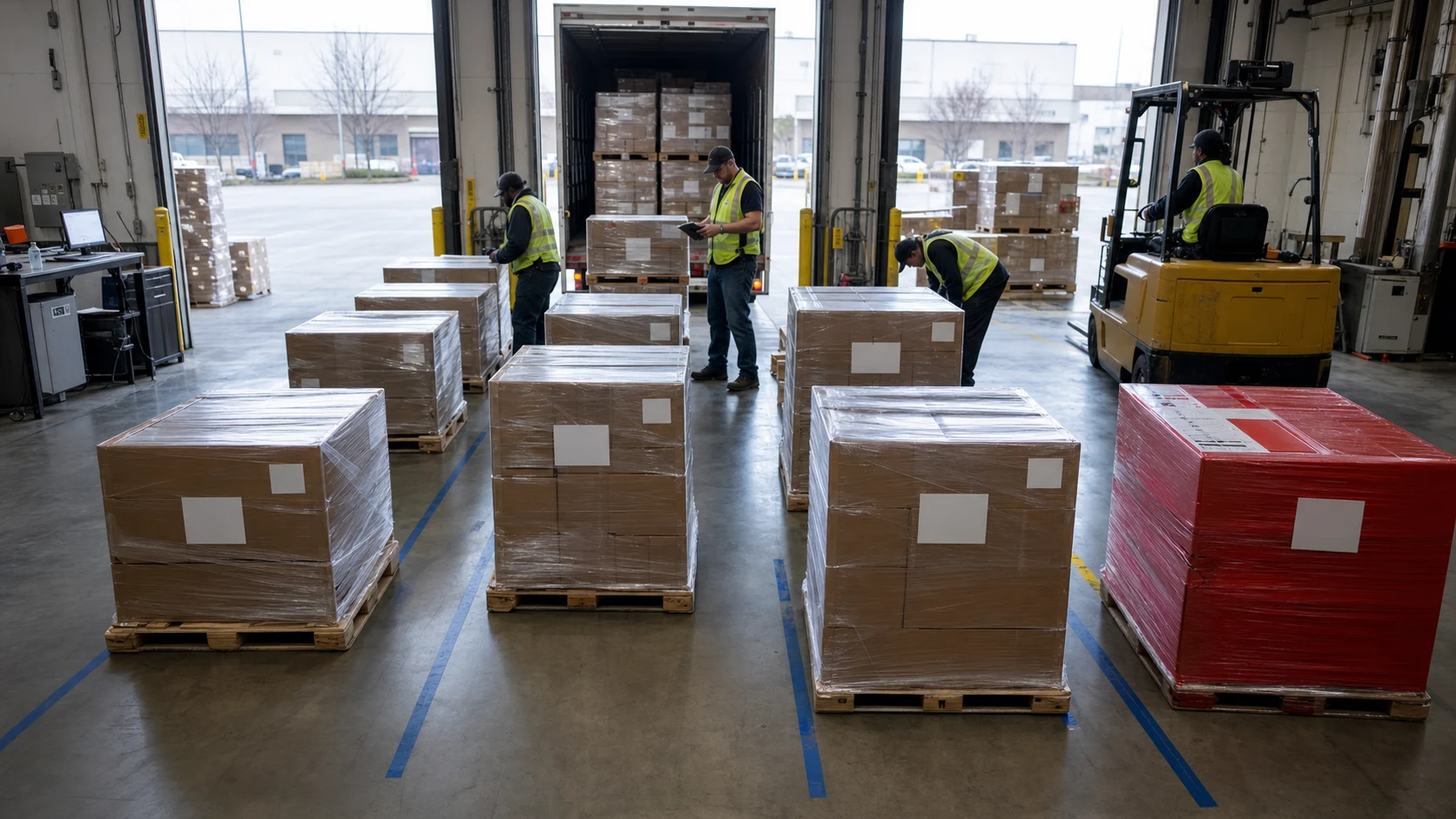
Inbound freight consolidation works only when lane density, supplier readiness, handling compatibility, and delivery timing outweigh added collection, dwell, inventory, and recovery cost.
Inbound freight consolidation is usually introduced with an arithmetic observation: several suppliers are sending partial loads into the same plant or distribution center, so combine them into fewer, fuller movements.
The arithmetic can be right and the program can still fail. One supplier misses the cutoff, another ships without usable labels, freight waits at the pool point, a critical component rides behind noncritical inventory, and the saved linehaul returns as handling, expedites, shortages, and production risk.
A consolidation candidate should pass one test:
Consolidate only when compatible freight, pickup geography, supplier-ready times, and destination demand form a repeatable pool whose total delivered cost and service outperform the direct baseline.
“Fewer trucks” is an output, not the business case. The design must price collection, the consolidation node, handling, inventory time, data work, exceptions, and recovery alongside the linehaul it expects to avoid.
What inbound freight consolidation actually changes
An inbound consolidation program coordinates shipments from multiple suppliers or release points before final delivery to a common destination or destination group. The operator may collect freight into a consolidation center, build scheduled multi-stop pickups, dynamically combine compatible orders, or merge components in transit.
Those designs solve different problems:
- Scheduled pool. Suppliers deliver or are collected into a fixed regional cutoff; the pool closes and departs on a defined cadence.
- Milk run. One vehicle follows a planned supplier route and delivers the combined load directly or through a node.
- Dynamic consolidation. Planning logic combines eligible shipments as they become ready, subject to delivery and compatibility rules.
- Origin consolidation center. A warehouse receives, verifies, stages, and builds larger destination loads.
- Merge-in-transit. Components from different origins are synchronized at a merge point for one customer delivery. EPA SmartWay's merge-in-transit operating note emphasizes the supplier coordination and information processing this model requires.
- Direct bypass. Freight that is urgent, incompatible, already a full load, or operationally unsuitable skips the pool.
EPA SmartWay's overview of shipper and logistics strategies describes LTL consolidation, co-loading, inventory-management changes, and merge-in-transit as distinct approaches. That is the right level of skepticism: “consolidation” is a family of network designs, not one default process.
Find a repeatable pool, not a promising week
Begin with shipment and order-line history, not annual freight spend. The data set should cover enough time to show weekday, month-end, promotion, shutdown, and seasonal behavior.
At minimum, capture:
- supplier ship-from location and hours;
- purchase order, release, line, and destination;
- supplier promised and actual ready time;
- requested and actual delivery window;
- pallet, carton, piece, weight, dimensions, and cube;
- commodity, value, handling, stackability, temperature, hazmat, food, and security attributes;
- packaging and label compliance;
- original mode, carrier, route, and charges;
- minimums, pickup, delivery, notification, detention, reclassification, and other accessorials;
- damage, shortage, rejection, and claim history;
- expedites and reason;
- inventory effect of early or late delivery;
- production, customer, or service consequence of failure.
Then group candidates across three axes:
- Geographic density. Can collection happen without excessive stem and route miles?
- Time compatibility. Do ready times and due dates overlap enough to create a useful cutoff?
- Freight compatibility. Can the products share equipment, handling, staging, and risk controls?
Freight is not compatible merely because it moves to the same building. Odor, contamination, food, hazmat segregation, temperature, stackability, value, security, loading sequence, and damage susceptibility can disqualify a combination.
EPA SmartWay's current shipper tools and resources group load optimization with route and network optimization for a reason: fuller equipment is only useful when the network miles, mode, and service plan still work.
Use a lane-density calendar
Build a daily view showing what was actually ready—not what the purchase order originally predicted. For each proposed pool, calculate:
- eligible shipments and suppliers;
- cumulative weight, cube, pallets, and floor positions;
- distance between collection points;
- earliest ready time;
- latest allowable departure;
- destination appointment capacity;
- compatible equipment;
- unpooled residual freight.
Look for a pattern that repeats without extraordinary planner intervention. A one-time full trailer created by holding three orders does not establish a lane. A modest, dependable pool can be more valuable than a larger theoretical one that routinely breaks its cutoff. SmartWay's co-loading guidance usefully distinguishes opportunistic combinations from actively planned collaboration; an inbound program should state which one it is designed to support.
Compare total delivered cost
Create a baseline from the current direct movements. Normalize accessorials, minimums, class or density assumptions, and service requirements using the freight-rate architecture.
Then compare:
consolidated total cost = supplier collection + inbound node receipt + handling + staging/storage + outbound linehaul + trailer/yard + systems/admin + added inventory time + expected damage/shortage + expected expedite/recovery
against:
direct total cost = current linehaul and accessorials + current receiving/admin + expected direct-service failure and recovery
Include internal cost only where the program changes it. If the direct process already requires the same purchase-order administration, do not charge it only to consolidation. If the pool requires a new ASN validation desk or after-hours receiving shift, include it.
No universal weight, pallet count, or number of suppliers makes consolidation economic. The break-even point depends on lane length, collection geometry, freight class or density, handling, cadence, equipment, and service consequence.
Value inventory time explicitly
Consolidation often creates waiting. The earliest-ready shipment may sit until the pool cutoff or until a late supplier arrives.
Estimate:
- capital carrying cost;
- depreciation or obsolescence;
- cold-chain or controlled-condition cost;
- production-shortage risk;
- lost-sales or service risk;
- safety-stock change;
- space occupied at supplier, pool point, and destination.
The answer can differ by item. Holding routine packaging material for one day may be harmless. Holding a line-down component behind it may be irrational even when both fit in the same trailer.
Use a maximum-hold rule by service class and a bypass trigger before the program launches.
Build the timing architecture backward from need
A viable pool has an explicit sequence:
order or release → supplier acknowledgment → freight ready → pickup → pool receipt → verification and exception clearance → cutoff → load close → departure → destination appointment → receipt
Define the event and source for every clock. “Supplier ready” should mean packaged, labeled, documented, accessible, and available for the planned vehicle—not production complete with two hours of staging work remaining.
Work backward from the destination's actual need time. Protect:
- destination appointment and unload capacity;
- transit variability;
- pool handling and reconciliation;
- collection-route variability;
- supplier preparation time;
- exception-resolution buffer.
The cutoff should leave room for controlled work, not assume perfect handoffs. A later cutoff may increase pool density while reducing recoverability. Test that tradeoff with historical ready-time distributions.
Separate forecast, release, and shipment notice
Forecasts help plan capacity; releases authorize or specify demand; shipment notices describe what actually moved. Combining them into one status creates false confidence.
X12's official transaction-set catalog distinguishes, among other messages:
- the 830 Planning Schedule with Release Capability for forecast and material-release information;
- the 850 Purchase Order for placing an order;
- the 862 Shipping Schedule for more precise supplier shipping requirements;
- the 856 Ship Notice/Manifest for shipment contents, packaging, markings, carrier, and equipment configuration.
An API or portal may use different message names. The control principle is the same: preserve version and purpose. An ASN should not silently change the purchase order, and a forecast should not be treated as proof that the shipment is ready.
Supplier compliance is part of transportation design
A consolidation center cannot reliably correct every upstream defect without adding cost and delay. Publish a supplier-routing standard that defines:
- order and release acknowledgment;
- pickup-request lead time;
- ready-time definition and change notice;
- packaging, pallet, stackability, and labeling requirements;
- handling-unit and purchase-order references;
- ASN content and timing;
- exact weight and dimension expectations;
- carrier and appointment instructions;
- overage, shortage, substitution, partial, and backorder treatment;
- temperature, hazmat, food, export, security, or other special requirements;
- contact and escalation;
- chargeback or corrective-action process, where contractually applicable.
Do not let chargebacks substitute for flow. A penalty may recover a small administrative cost while the destination still lacks a critical part. Use supplier-performance data to adjust cutoff, pickup frequency, bypass eligibility, and corrective action.
A useful supplier scorecard includes ready-on-time performance, ASN accuracy, label scan rate, packaging compliance, quantity accuracy, exception response, and expedite cause. Segment planned supplier behavior from carrier pickup performance and consolidation-center execution.
Maintain physical identity through the pool
At receipt, verify the supplier, purchase order, handling unit, count, condition, and required controls before making freight available to the pool. Record the inbound carrier, trailer, seal where applicable, arrival, door, unload, and receipt times.
The GS1 Logistic Label Guideline describes the Serial Shipping Container Code as an identifier for a logistics unit. GS1's transport-process implementation guideline shows how a physical logistics-unit identifier can support sorting and tracking through hubs and consolidation points.
Use an SSCC or another governed unique identifier to connect:
- supplier shipment and purchase-order lines;
- physical pallet, carton group, tote, or other logistics unit;
- inbound receipt and condition;
- pool location and hold status;
- outbound load and destination;
- delivery and any exception.
Do not relabel without maintaining the parent-child or old-new link. Do not load an unidentified pallet because “the driver knows where it goes.” Quarantine overages, unreadable labels, mixed purchase orders, and damaged units in a defined exception location.
Before closing the outbound trailer, reconcile expected, received, held, bypassed, and loaded quantities. Preserve outbound carrier and equipment, handling-unit manifest, load sequence, seal, count, weight, and release.
Design bypasses before exceptions arrive
A program that forces every shipment through the pool will eventually damage service. Define direct-shipment triggers for:
- a full or near-full direct load that does not benefit from handling;
- line-down, patient-critical, customer-critical, or otherwise urgent freight;
- freight that will miss the maximum hold or delivery time;
- high-value, theft-sensitive, fragile, nonstackable, oversized, or specialized cargo;
- incompatible temperature, food, hazmat, contamination, or security conditions;
- a supplier outside the collection geometry;
- pool-node outage, capacity constraint, labor failure, or system failure;
- late freight whose next pool departure cannot meet need;
- a destination that cannot accept the consolidated arrival pattern.
Name who authorizes the bypass and how its cost and root cause are coded. If planners can bypass without a reason, savings leak. If no one can bypass, service fails.
Recovery belongs in the rate model
Predetermine options when one supplier misses:
- depart without the freight and move it on the next pool;
- depart and expedite the missed freight;
- hold the consolidated load;
- remove and replan affected orders;
- send a direct vehicle to collect the late item.
The right branch depends on need date, item criticality, downstream appointment, driver time, handling, and customer consequence. Record the incremental cost against the cause that triggered it.
Select the consolidation node for the flow
The lowest handling rate is not necessarily the best node. Test:
- location relative to supplier density, destination, highways, and carrier capacity;
- inbound and outbound operating hours;
- legal yard and trailer capacity;
- compatible doors, material-handling equipment, scales, and packaging capability;
- staging capacity by normal, hold, damage, regulated, and temperature zone;
- shipment, handling-unit, ASN, and inventory-system integration;
- appointment, cutoff, and outbound dispatch control;
- count, condition, seal, and claims evidence;
- security and access;
- labor plan for peaks;
- business continuity and recovery capacity.
The warehouse and 3PL selection guide provides a scenario-based diligence model. Use UniteCargo's 3PL directory and warehouse directory to identify potential operators, then require them to model the same shipment history and exceptions.
Where a 3PL manages routing, carriers, and the facility, identify its role and subcontractors. An integrated invoice does not eliminate distinct carrier, broker, warehouse, and claims responsibilities.
Measure savings without losing the operation
Establish the direct baseline before the pilot. Then use a balanced scorecard:
Economic
- total delivered freight cost per unit, order, and pound or cube;
- avoided direct shipments and minimum charges;
- collection, handling, storage, and administration;
- expedites, rework, and recovery;
- accessorials and detention;
- inventory carrying and safety-stock effect.
Flow and service
- eligible freight consolidated;
- outbound load factor by weight, cube, and floor positions;
- supplier ready-on-time performance;
- planned versus actual cutoff and departure;
- handling-unit dwell;
- destination on-time and complete receipt;
- pool bypass and missed-connection rate.
Quality and control
- ASN and label accuracy;
- receipt and load reconciliation;
- shortage, damage, contamination, and misroute;
- exception age;
- claims and evidence completeness;
- manual touches and planner overrides.
Do not use consolidated shipments ÷ all shipments as the primary success metric. The program can improve that ratio by holding freight longer or forcing unsuitable loads through the node. The goal is a better network outcome, not maximum participation.
Run a bounded pilot
Choose a supplier region, destination, commodity family, and operating cadence with enough historical density to test. Freeze the baseline and document the counterfactual: how each pilot shipment would have moved directly.
The pilot should encounter routine variation, not only hand-selected perfect weeks. Require:
- supplier onboarding and data validation;
- explicit cutoff and maximum hold;
- direct bypass rules;
- end-to-end handling-unit identity;
- one owner for pool release;
- one owner for transportation recovery;
- total-cost and service measurement;
- post-event review of every expedite, miss, shortage, and damage.
Expand only if savings persist after node cost, inventory time, and exceptions—and if on-time, complete, damage, and critical-item performance remain inside the agreed service boundary.
The go/no-go rule
Inbound freight consolidation creates value when it converts repeatable order and lane density into larger movements without obscuring urgency, identity, or custody. It destroys value when the network buys linehaul savings by adding uncontrolled waiting and handling.
Anchor the program in the operator's map of how freight moves across America, select the appropriate FTL, LTL, or partial-truckload service, and make the pool prove itself against the direct baseline.
Sources and further reading
- EPA SmartWay: Shipper Partner Tools and Resources
- EPA SmartWay: Overview of Strategies for Logistics and Shipper Companies
- EPA SmartWay: Co-loading for Logistics and Shipper Companies
- EPA SmartWay: Merge-In-Transit for Logistics and Shipper Companies
- X12: Transaction Sets for planning, ordering, scheduling, and shipment notices
- GS1: Logistic Label Guideline
- GS1: Encoding Transport Process Information Implementation Guideline