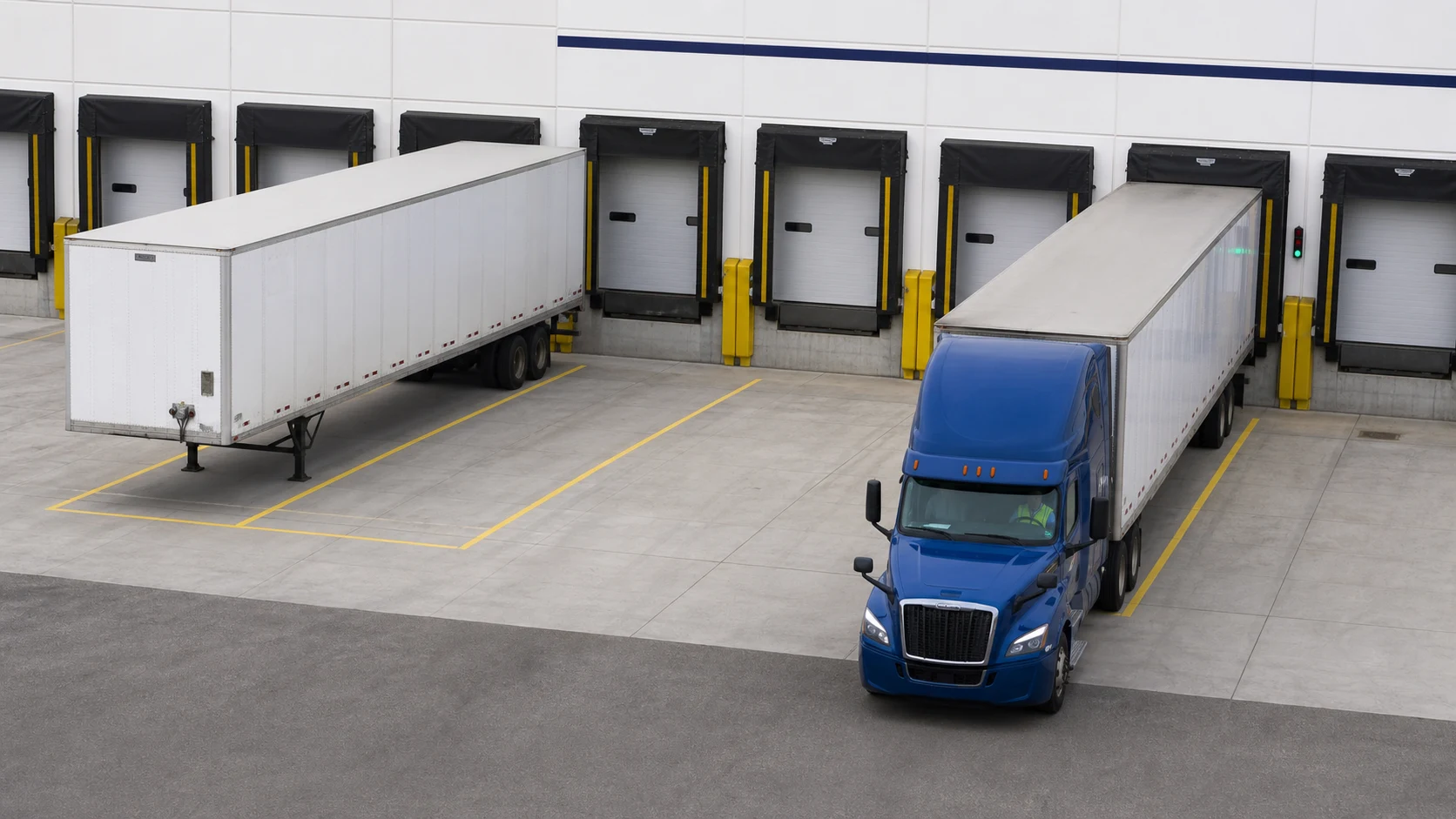
Live and drop operations consume different combinations of driver, tractor, trailer, yard, labor, and inventory capacity; the right model prices all of them.
The usual argument for a drop-trailer program is seductively simple: drivers stop waiting, the warehouse loads when convenient, and everyone gains capacity.
That can be true. It can also produce an overcrowded yard, an underfunded trailer pool, loaded inventory that no one can locate, and a new set of equipment, damage, and detention disputes. Drop service does not eliminate dwell. It moves dwell from a driver and tractor to a trailer, yard slot, and inventory position.
The decision gets clearer when every scarce resource is visible:
Choose the model that minimizes total constrained-resource time at the required service level. Count drivers, tractors, trailers, yard positions, switcher moves, dock labor, inventory, and recovery—not just minutes at the door.
For stable, dense volume with sufficient yard control, drop service can decouple transportation from warehouse labor and create real flexibility. For irregular volume, scarce yard space, specialized equipment, or short predictable service, live loading can be the stronger design.
Live load and drop trailer are operating models
In a live load or live unload, the driver generally remains with the tractor and trailer while the facility performs the work, then departs with the same equipment. The appointment therefore reserves carrier power and driver time as well as facility capacity.
In a drop-trailer operation, the carrier leaves a trailer at the site and departs with a tractor, often taking an empty or preloaded trailer. The facility loads or unloads the dropped equipment without requiring that original driver to wait. “Drop and hook” describes the quick tractor exchange that a well-run pool can support.
The labels do not define every commercial or custody term. A carrier can provide a small pool without guaranteed hook-ready freight. A shipper can own the trailers. A trailer can be dropped for one load, maintained as standing pool equipment, or used in a dedicated shuttle. Define the exact service before comparing rates.
| Decision factor | Live load or unload | Drop-trailer program |
|---|---|---|
| Transportation resource held during handling | Driver, tractor, and trailer | Primarily trailer; sometimes chassis or other equipment |
| Facility labor timing | Coupled to appointment | Can be decoupled within agreed ready-time window |
| Yard demand | Queue and maneuvering space | Persistent trailer positions plus maneuvering space |
| Equipment quantity | Lower trailer requirement if turns are reliable | Higher trailer requirement to cover loaded, empty, in-process, and transit states |
| Best volume pattern | Low, irregular, specialized, or highly scheduled | Stable, repetitive, dense, and forecastable |
| Main control risk | Driver dwell and schedule failure | Pool imbalance, trailer dwell, yard accuracy, defects, and loaded-inventory delay |
| Freight-ready dependency at arrival | Immediate | Hook-ready performance still matters at pickup |
| Capital or lease burden | Lower trailer pool cost | More trailers, maintenance exposure, and repositioning |
Start with the resource bridge
Compare one complete operating cycle.
For live service:
total live cost = transportation price + driver/tractor waiting + schedule-failure cost + dock disruption + detention/accessorial exposure + recovery cost
For drop service:
total drop cost = transportation price + trailer ownership or lease + maintenance + pool repositioning + yard and switcher work + trailer dwell charges + inventory aging + damage/security exposure + stockout recovery
Use the actual party cost where you can and an agreed shadow price where a constrained resource is not separately invoiced. A shipper may not receive a line item for a yard slot, but a full yard can prevent receipts, require an overflow lot, or add switcher moves. A carrier may include trailer capital in a bundled rate, but the network still pays when trailers sit loaded for days.
The freight-pricing architecture helps separate linehaul, fuel, minimums, and accessorials. For this decision, add the facility and equipment costs that do not appear on a freight invoice.
Measure complete trailer cycle time
Do not size a pool from daily load count alone. Measure each state:
- empty trailer available at site;
- assigned to a shipment;
- moved to a door;
- loading or unloading begins;
- work completes;
- paperwork, seal, and release complete;
- trailer marked ready;
- carrier dispatch receives the ready event;
- driver arrives;
- trailer departs;
- linehaul and destination cycle;
- empty return or reposition.
The useful pool calculation is based on observed cycle time and peak variability by stage. A nominal five-load-per-day program can require very different pools when one site turns equipment in six hours and another holds loaded trailers through a weekend.
There is no universal “two trailers per daily load” or similar ratio. Start with empirical cycle distributions, scheduled volume, day-of-week peaks, maintenance reserve, and a defined service buffer. Then test what happens when a trailer is rejected, a load is canceled, or the destination holds equipment longer than planned.
When live loading is the better answer
Live service tends to be stronger when:
- shipment volume is low or highly irregular;
- the facility has little legal trailer parking;
- handling time is short and predictably staffed;
- equipment is specialized, scarce, high-value, temperature-controlled, or dedicated to a commodity;
- the shipper cannot maintain accurate yard inventory;
- cargo requires immediate driver or carrier participation in inspection or securement;
- loaded equipment would create unacceptable theft, contamination, or inventory risk;
- the lane does not support reliable empty-trailer repositioning;
- demand changes faster than a practical pool can rebalance.
Live does not have to mean unmanaged waiting. A capacity-based dock appointment process can reserve the correct door, labor, equipment, and work duration. The facility should expose event clocks and escalation before delay turns into a commercial detention dispute.
For a low-volume site, improving freight readiness and appointment accuracy can be cheaper than adding trailer capital and yard complexity.
When a drop program creates real capacity
Drop service is a strong candidate when:
- origin-destination volume is stable enough to forecast and pool;
- multiple loads move each operating day or in predictable waves;
- the facility needs to load around production or labor variability;
- there is controlled yard space for empties, in-process units, loaded units, holds, and defects;
- the carrier can supply and rebalance compatible trailers;
- the shipper can issue a reliable hook-ready event;
- a switcher or yard process can move trailers without blocking docks;
- shipment identity, trailer identity, seal, and contents remain linked;
- both parties can measure cycle time and enforce dwell limits.
The EPA's current freight-sustainability leadership guidance lists scheduling improvements and drop-and-hook among strategies shippers can consider. That is a design opportunity, not proof that every drop program reduces cost or emissions. Extra repositioning, an oversized pool, and prolonged loaded dwell can erase the expected gain.
Treat the yard as controlled inventory
A drop trailer is both equipment and a location containing inventory. The yard system—or a disciplined manual control at small scale—should preserve:
- trailer number and standardized carrier or owner identity;
- equipment type, dimensions, and special capability;
- exact yard position;
- empty, assigned, at door, loading, loaded, hold, ready, defect, or unavailable status;
- shipment, order, and handling-unit identifiers;
- seal number and every authorized seal change;
- arrival, door, work-complete, ready, and departure times;
- last physical verification and last system update;
- damage or maintenance status;
- refrigeration setpoint, fuel, and alarm status where applicable;
- contractual free time or pool-dwell clock;
- responsible owner for the next move.
Require a physical yard reconciliation at a frequency matched to volume and risk. System status is not proof that a trailer occupies the expected spot. Scan or verify the equipment identifier on every gate and yard move. Keep loaded, empty, hold, and defect locations visually and digitally distinct.
Where handling units need traceability, the GS1 Logistic Label Guideline explains use of the Serial Shipping Container Code to identify a logistics unit and link it to electronic information. An SSCC does not replace the trailer number or seal; it creates a controlled connection between physical units and shipment data.
Make “ready” a verified event
A trailer is not hook-ready because loading stopped. Define ready as all required conditions complete:
- freight loaded and counted;
- cargo securement process complete;
- trailer doors closed and seal applied where required;
- shipment and trailer match;
- weight and axle-distribution controls complete where applicable;
- documents and system release complete;
- no quality, credit, security, or customs hold;
- trailer condition fit for departure;
- yard position accessible;
- carrier notified through the agreed channel.
Measure false-ready events. They consume a driver trip and reveal failures that a simple “pickup on time” metric hides.
Preserve the cargo-control boundary
Federal motor-carrier rules place duties on the driver and motor carrier before and during operation. Under 49 CFR § 392.9, a commercial motor vehicle may not be driven unless its cargo is properly distributed and adequately secured. The section also contains ongoing inspection provisions and a specific exception to those ongoing checks for certain sealed or impracticable-to-inspect cargo. That exception should not be misread as erasing the general requirement before operation.
When a shipper loads and seals a trailer without the driver's observation, define how the carrier can evaluate safe loading. The FMCSA addresses that question in its guidance on shipper-loaded and sealed trailers. Operational controls may include trained-loader certification, accurate weight data, load diagrams, securement records, seal records, and a documented exception process. The carrier must still determine what evidence is sufficient for its operation.
At each drop and pickup, record:
- exterior and visible interior condition;
- trailer, shipment, and seal identifiers;
- loaded or empty status;
- custody transfer time and location;
- damage, contamination, odor, water, tire, light, landing-gear, door, or refrigeration exceptions;
- names or electronic identities of both parties.
This record supports both equipment-damage administration and the freight-claims evidence chain. Do not wait for a shortage or floor failure to decide who was responsible for the trailer during each interval.
Assign equipment maintenance and defect control
Do not assume “carrier trailer” resolves every maintenance question. Identify who owns the unit, who has control, who performs inspections, how the facility reports a defect, whether the unit can be moved, and who authorizes repair.
49 CFR § 396.3 sets systematic inspection, repair, and maintenance duties for motor carriers and intermodal equipment providers within its scope. A shipper's yard process should not purport to replace the regulated party's program. It should prevent known damage from disappearing into a pool and provide prompt, attributable notice.
Create a defect quarantine. Mark the physical unit and system record, block assignment, photograph the condition, notify the agreed owner, and record disposition. Never let a pool shortage pressure staff into releasing equipment already identified as unsafe or unsuitable.
Design dock safety for uncoupled trailers
An uncoupled semitrailer changes the loading risk. OSHA's powered-industrial-truck rule states that fixed jacks may be necessary to support an uncoupled semitrailer and prevent upending during loading or unloading. The same rule addresses brakes and wheel chocks in specified trailer-boarded operations. OSHA's dockboard requirements cover load capacity, securing portable boards, and measures intended to prevent vehicle movement.
The site must translate the controlling requirements, hazard assessment, trailer restraint system, and equipment instructions into a specific procedure. Define who verifies support and restraint, who authorizes entry, and who releases the trailer. A drop program should increase flexibility, not turn unfamiliar trailers into improvised storage platforms.
This article is operational education, not legal or safety advice.
Put the operating contract around the pool
The agreement or program exhibit should address:
- expected load volume and forecast cadence;
- required pool by location and equipment type;
- shipper-owned, carrier-owned, leased, or substituted equipment;
- initial placement and ongoing rebalance responsibility;
- acceptable equipment age, condition, markings, and capabilities;
- maintenance, road repair, tire, refrigeration, and inspection responsibility;
- yard access, keys, seals, and security;
- loaded and empty dwell allowances and charges;
- hook-ready definition and notification;
- false-ready, no-empty, no-trailer, and rejected-equipment events;
- responsibility for loading, count, securement, weight, and sealing;
- damage documentation, notice, repair authorization, and dispute process;
- theft, casualty, cargo, and equipment insurance terms;
- termination, pool removal, stranded units, and final reconciliation.
Separate equipment possession, cargo custody, transportation service, and commercial charges. They may transfer at different times.
If a broker or 3PL manages the pool, identify whether it is arranging carrier equipment, leasing equipment, operating a yard service, or assuming another contractual role. The broker, 3PL, and freight-forwarder role guide helps prevent a generic label from obscuring the actual counterparty.
Use a balanced scorecard
Measure both sides of the decoupling:
| Transportation flow | Facility and equipment control |
|---|---|
| Driver gate-to-gate time | Empty-arrival to assignment time |
| Hook-ready accuracy | Assignment to work-complete time |
| Trailer available at scheduled pickup | Work-complete to ready time |
| Departures completed as planned | Ready-to-departure time |
| Recovery moves and bobtails | Pool stockouts and excess units |
| Carrier-caused versus facility-caused failures | Defects, lost trailers, and yard-record mismatches |
Also track loaded inventory age, trailer turns, switcher moves per load, damage frequency, unauthorized seal changes, and total cost per completed shipment. Segment by facility, lane, equipment, day of week, and program maturity.
Do not celebrate a faster tractor turn while trailer cycle time doubles. Do not reduce the pool until stockouts force live recovery. The purpose is a stable operating system, not one attractive metric.
Pilot before committing the network
Start with one facility, carrier, equipment class, and repeatable lane group. Establish the live-service baseline, including dwell, detention, service failures, labor overtime, and total cost. Run the drop program long enough to include weekends, demand peaks, maintenance events, and at least one real exception.
Before expansion, require:
- accurate yard inventory;
- reliable ready messages;
- acceptable pool stockout and excess levels;
- controlled equipment defects;
- proven trailer support and dock-safety procedure;
- stable service and total-cost improvement;
- a documented recovery playbook.
Use UniteCargo's carrier directory to identify potential transportation providers and its warehouse directory for facility partners. Apply the same motor-carrier vetting process and scenario-based warehouse diligence regardless of which operating model looks attractive.
Make the capacity choice explicit
Live and drop are not maturity levels. They are different allocations of scarce capacity.
Choose live service when immediate shared execution and low equipment overhead outperform decoupling. Choose drop when stable volume, yard discipline, and a properly sized pool let transportation and warehouse labor work independently. In either case, preserve the events, custody, safety controls, and cost objects that reveal where time actually went.
Sources and further reading
- FMCSA: 49 CFR 392.9 guidance for shipper-loaded and sealed trailers
- eCFR: 49 CFR 396.3, Inspection, Repair, and Maintenance
- Legal Information Institute: 49 CFR 392.9, Inspection of Cargo and Securement Devices
- OSHA: 29 CFR 1910.178, Powered Industrial Trucks
- OSHA: 29 CFR 1910.26, Dockboards
- EPA SmartWay: Freight Sustainability Leadership
- GS1: Logistic Label Guideline