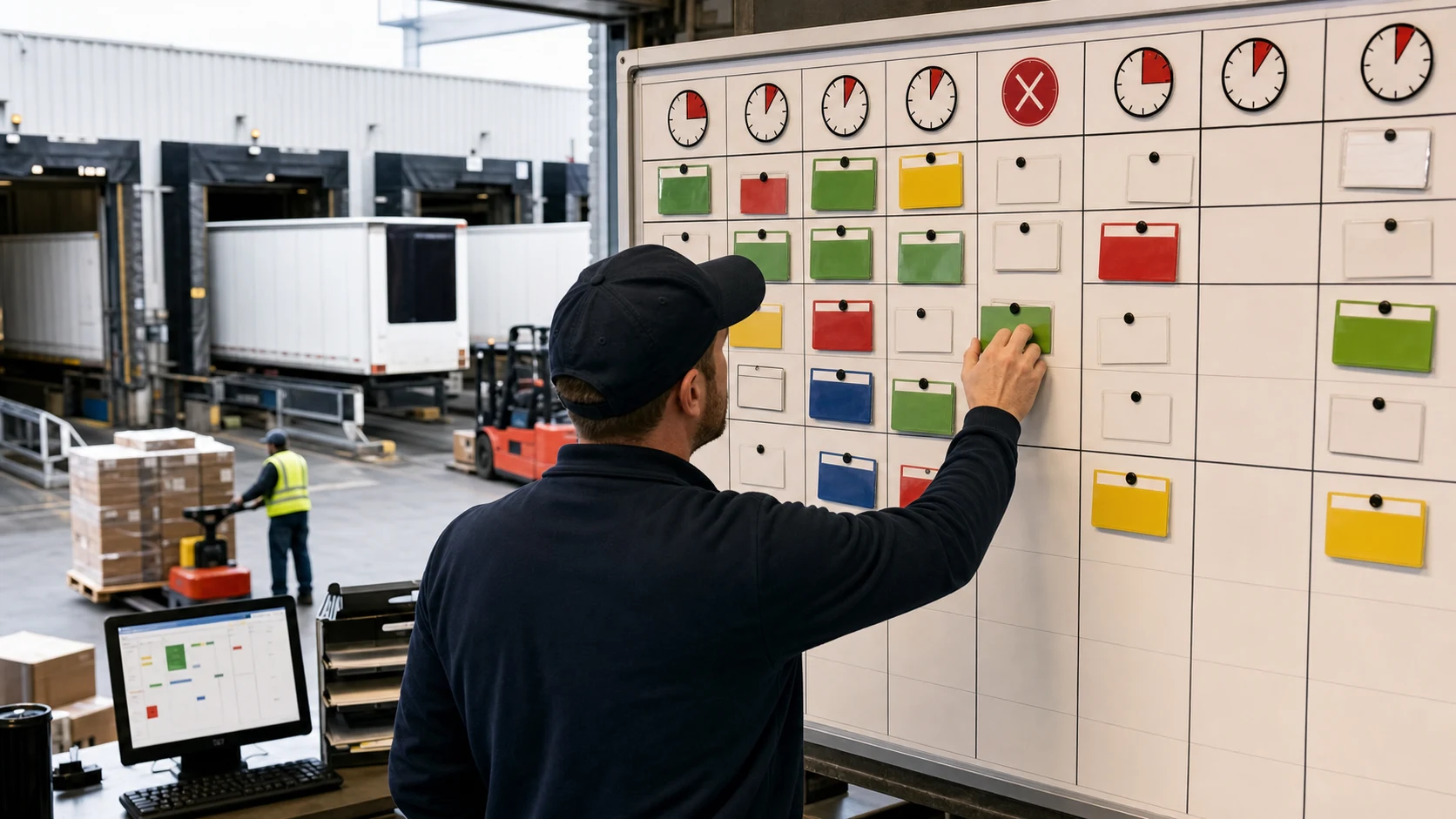
A dock appointment should allocate compatible doors, labor, yard space, and freight readiness—not merely place a carrier on a calendar.
A dock appointment is often treated as a calendar entry: carrier, date, time, confirmation number. That is the visible artifact, not the operating decision.
The facility is actually committing several constrained resources at once: a compatible door, yard space, labor, material-handling equipment, inventory or receiving readiness, and enough processing time for the shipment presented. If any one of those is missing, a “confirmed” appointment can still become a queue.
The practical rule is:
Confirm an appointment only against verified processing capacity and freight readiness. Then preserve the physical event clocks separately from any contractual detention clock.
This distinction matters. The FMCSA's current detention research program is studying delay at shipper and receiver facilities because earlier data could not consistently separate normal loading or unloading time from detention. The agency's earlier driver-fatigue research establishes the safety relevance of long waiting, but its 2014 final report is foundational evidence rather than a current market benchmark. Neither source creates a universal commercial threshold or payment rule. A facility therefore needs its own operational definition of dwell, while procurement and carriers separately agree on free time, rates, evidence, and billing.
Schedule the work, not the truck
Start with the work content. A 53-foot trailer carrying 26 uniform pallets is not the same appointment as a floor-loaded import container, even if both occupy one door. Nor are a palletized receipt that can go straight to reserve storage and a receipt that requires sampling, lot capture, sortation, or quality hold.
Create service classes that reflect material differences in processing. A useful appointment request can include:
- shipping or receiving facility and requested date;
- inbound or outbound movement;
- purchase orders, shipment IDs, and customer or supplier;
- performing carrier and equipment type;
- live load, live unload, drop, or pickup;
- trailer or container number when known;
- pallet, carton, piece, and weight estimates;
- floor-loaded, slip-sheeted, clamped, oversized, or other handling condition;
- commodity and any temperature, food, hazmat, security, or inspection requirement;
- unload method and driver-assist or lumper expectation;
- seal status and whether opening is authorized;
- inventory-ready time for outbound freight;
- requested duration or facility service class;
- contact authorized to resolve a same-day exception.
Do not make carriers guess which fields matter. Publish the required data, validation rules, lead time, and change process in the facility instructions and routing guide. If the load changes after confirmation—more pallets, different equipment, new temperature requirement—the appointment should be revalidated, not silently left in the original slot.
Build capacity by compatibility
Door count is a poor capacity model. Each time block should be constrained by at least:
- Door compatibility. Height, dock equipment, trailer access, temperature zone, security zone, and inbound or outbound flow.
- Labor capacity. Qualified headcount by shift, break pattern, expected productivity, and competing work.
- Material-handling capacity. Forklifts, clamps, pallet jacks, dock plates, spotters, and charged batteries.
- Staging capacity. Available floor or outbound lane space. A door cannot keep producing if completed freight has nowhere to go.
- Yard capacity. Gate throughput, legal queue space, trailer parking, maneuvering room, and switcher capacity.
- Systems and control work. Receipt creation, ASN matching, lot capture, quality release, paperwork, and exception processing.
Model duration from observed service time by service class, not one average across all loads. Medians help with a typical plan; upper-percentile duration is more useful for protecting the schedule from routine variability. Segment chronic exceptions instead of hiding them in an average.
Reserve controlled capacity for late upstream arrivals, urgent production material, rejected receipts, and other genuine exceptions. If every slot is sold to the nominal plan, the first disruption consumes capacity promised to every load after it.
Use one appointment state machine
Email, portals, EDI, APIs, and phone calls can all carry an appointment request. The channel matters less than shared state semantics.
X12 maintains a Transportation Appointment Schedule Information transaction set that supports appointment requests and acceptances between carriers and trading partners. A portal or API can work equally well, but neither prevents ambiguity unless both parties know what each status means.
Use a controlled sequence such as:
Requested → Pending validation → Confirmed → Arrived → Checked in → Queued → Called to door → At door → In process → Work complete → Released → Gate out
Add terminal states for canceled, rejected, late-deferred, and no-show appointments. Record who changed the state, when, why, and which appointment version was active.
“Requested” must not mean “confirmed.” “Arrived” should not be inferred from a driver calling dispatch 20 miles away. “Work complete” should not automatically mean “released” if paperwork or a quality hold still prevents departure. These distinctions expose where the clock is actually being consumed.
Preserve the physical event chain
At minimum, retain:
| Event | What it proves |
|---|---|
| Appointment requested | The carrier or supplier asked for a specific service window |
| Appointment confirmed or revised | The facility committed to the active window and requirements |
| Geofence or property arrival | The equipment reached a defined physical boundary |
| Gate check-in | The facility accepted the driver into its check-in process |
| Queue entry | The load became eligible for a door |
| Door call | The facility instructed movement to a dock |
| Docked and secured | The trailer reached the assigned door and the safety process began |
| Work start and completion | The actual handling interval |
| Paperwork complete | Documents no longer prevented release |
| Release and gate-out | Facility control ended and equipment departed |
Define the source hierarchy before records conflict. A gate transaction may control check-in; a yard-management event may control door arrival; a warehouse-management scan may control unload completion; a signed or electronic release may control departure. Preserve original timestamps and later corrections rather than overwriting inconvenient data.
The commercial detention clock is a separate calculation. The applicable contract, rate confirmation, carrier rule, or tariff should define its start, free-time allowance, stop, increments, exclusions, notice, and evidence. The broader guide to detention, demurrage, per diem, and storage explains why an invoice label alone does not identify the controlling clock.
Write arrival rules for the real site
“Arrive on time” is not a gate process. Facility instructions should tell the driver:
- the exact entrance and any prohibited approach roads;
- operating hours and local time zone;
- how early the truck may enter and where early arrivals may legally wait;
- the late-arrival grace and who can authorize an exception;
- required confirmation, shipment, trailer, seal, and driver identifiers;
- PPE, check-in, restroom, escort, and phone-use rules;
- whether a trailer must be clean, precooled, food-grade, or otherwise documented;
- where to stage and how the door call will be delivered;
- what to do if the gate is closed, the portal fails, or load information is wrong.
Do not issue an early-arrival prohibition without identifying a safe alternative. Do not tell a driver to “park nearby” when the surrounding roads prohibit commercial parking. A no-idling policy should be paired with realistic queue design and driver conditions. The EPA's current idle-reduction guidance encourages shipper policies that reduce unnecessary idling; a multi-hour opaque queue simply transfers the same operating failure outside the gate.
Hours-of-service compliance remains the motor carrier's and driver's responsibility under the applicable rules. The facility should still avoid instructions that assume unlimited driver time. The FMCSA interstate hours-of-service guide is a useful regulatory reference, but it is not a substitute for the carrier evaluating the actual driver, operation, and exceptions.
Make early, late, and no-show treatment explicit
There is no universally correct 15-, 30-, or 60-minute grace period. Choose rules from the facility's actual operating constraints, then apply them consistently.
For each service class, define:
- earliest permitted check-in;
- on-time window;
- late threshold;
- whether a late truck joins a standby queue, receives the next open slot, or must reschedule;
- whether the facility will preserve priority when the late arrival resulted from its own revision;
- cancellation deadline;
- no-show definition and evidence;
- escalation path for production-critical, regulated, or customer-priority freight.
A late rule should protect the loads that arrived as planned, not punish a driver mechanically. If the facility consistently starts on-time appointments late, strict carrier grace rules will not improve flow; they will manufacture disputes.
Give the queue an owner and a visible decision rule
Once a driver checks in, silence is the worst operating state. The yard or dock coordinator should own the queue and expose an estimated door time, even when that estimate changes.
Choose a queue rule deliberately. First-in, first-out is easy to explain but often inefficient when doors, freight, or labor are not interchangeable. A compatibility-based queue is usually stronger: select the earliest eligible load that can use the next available resource, while protecting on-time priority and limiting how long any load can be bypassed.
Every bypass needs a reason code:
- freight not ready;
- purchase order or ASN mismatch;
- wrong equipment;
- seal or security exception;
- quality or compliance hold;
- door or equipment outage;
- labor shortage;
- late arrival;
- carrier requested delay;
- priority override authorized by a named owner.
Do not use “operational delay” as a universal code. It prevents root-cause analysis and makes carrier evidence useless.
The exception desk needs authority. A gate clerk should not have to search for a buyer while a truck blocks the entrance. Name the owner for purchasing discrepancies, inventory readiness, quality, security, transportation, and system failure. Set an escalation clock and a disposition: correct and proceed, stage safely, reject with evidence, or reschedule.
Never let schedule pressure bypass dock safety
Throughput targets do not suspend loading-dock controls. OSHA's powered-industrial-truck rule requires brakes and wheel chocks in specified circumstances and recognizes that fixed jacks may be needed to support an uncoupled semitrailer during loading or unloading. Its dockboard standard addresses load capacity, securing portable dockboards, and preventing vehicle movement.
The site-specific safety process should define:
- who confirms trailer restraint, brakes, chocks, or equivalent controls;
- when an uncoupled trailer needs support against upending;
- who inspects the trailer floor and dockboard;
- how the driver and dock team communicate permission to enter or depart;
- how a red-light, restraint, or dock-equipment defect removes a door from service;
- how a trailer is released only after people and equipment are clear.
Use the controlling OSHA powered-industrial-truck text, the facility's hazard assessment, equipment instructions, and applicable law to build the process. This article provides operational education, not legal or safety advice.
Measure causes, not one blended dwell number
Total gate dwell is important, but it cannot identify the fix. Split it:
gate dwell = check-in processing + queue time + door approach + dock preparation + physical handling + exception time + paperwork/release + exit processing
Report distributions by service class, shift, door group, supplier or customer program, and appointment condition. An average can improve while the worst loads deteriorate.
A useful weekly board includes:
- appointment request-to-confirmation time;
- confirmed slots versus modeled capacity;
- on-time arrival and no-show rate;
- gate check-in duration;
- check-in-to-door time;
- door-to-work-start time;
- work duration by service class;
- work-complete-to-release time;
- total gate dwell;
- queue depth and age by hour;
- appointment changes by initiator;
- exception frequency and minutes by reason;
- carrier detention requests, approved amounts, and root cause;
- door utilization by compatible capacity, not nominal door count;
- safety holds and equipment downtime.
Assign an owner and action threshold to each metric. A dashboard that cannot trigger a schedule change, staffing action, supplier correction, maintenance response, or contract review is reporting, not control.
Audit the denominator
Exclude nothing silently. If a load is removed because the carrier arrived late, the freight was not ready, the equipment was wrong, or the system was down, retain it in an exception population. Otherwise, a facility can improve “average dwell” merely by discarding the loads that expose the process.
Compare appointment versions as well. If the receiver repeatedly revises appointments after dispatch, carrier on-time performance against the final window can look excellent while the network absorbs substantial replanning.
Test the process before scaling software
Run the operating design through difficult cases:
- A truck arrives on time, but the outbound order is not picked.
- The requested 30-minute unload is actually 1,200 floor-loaded cartons.
- A driver arrives early because the prior stop released unexpectedly.
- The appointment portal is unavailable at the gate.
- A reefer setpoint or seal does not match the shipment record.
- An uncoupled drop trailer has a damaged landing gear or floor.
- Two production-critical inbound loads compete for one compatible door.
- Work finishes, but a quality hold blocks paperwork and release.
- A carrier requests detention and the gate, geofence, and signed times differ.
- A shift change and meal break coincide with the daily appointment peak.
For each case, identify the state, decision owner, evidence source, queue treatment, safety control, carrier communication, and commercial consequence. If the answer depends on one experienced coordinator remembering what to do, the design is not ready to automate.
A practical appointment-control checklist
Before calling the dock schedule controlled, verify that:
- service classes describe actual handling work;
- each slot consumes compatible door, labor, equipment, staging, and yard capacity;
- required appointment data and validation rules are published;
- requested and confirmed states are distinct;
- revisions preserve version, actor, time, and reason;
- physical event clocks are captured from defined sources;
- detention terms remain a separate contractual calculation;
- early, late, cancellation, and no-show rules match site reality;
- the queue has an owner, visible estimate, and bypass rules;
- exception codes lead to named decision owners;
- schedule pressure cannot bypass trailer and dock safety;
- performance is segmented by service class and exception cause;
- carrier disputes can be reconstructed from original evidence.
A warehouse or 3PL procurement process should test these controls with actual lane and load scenarios, not a software demonstration. The warehouse and 3PL selection guide provides the broader diligence structure. UniteCargo's warehouse directory and 3PL directory can help identify candidates; the operating test still belongs to the buyer.
The operating standard
Good dock appointment scheduling does not promise that every day will match the calendar. It makes capacity honest, deviations visible, queues governable, and evidence reconstructable.
Place those facility events inside the broader operator's map of how freight moves across America. The appointment is one controlled handoff in that chain—not a magic timestamp that transfers every delay to the carrier.
Sources and further reading
- FMCSA: Impact of Driver Detention Time on Safety and Operations
- FMCSA: Effects of Detention Times on Commercial Motor Vehicle Driver Fatigue
- OSHA: 29 CFR 1910.178, Powered Industrial Trucks
- OSHA: 29 CFR 1910.26, Dockboards
- FMCSA: Interstate Truck Driver's Guide to Hours of Service
- EPA SmartWay: Idle Reduction
- X12: Transportation Appointment Schedule Information and other transaction sets