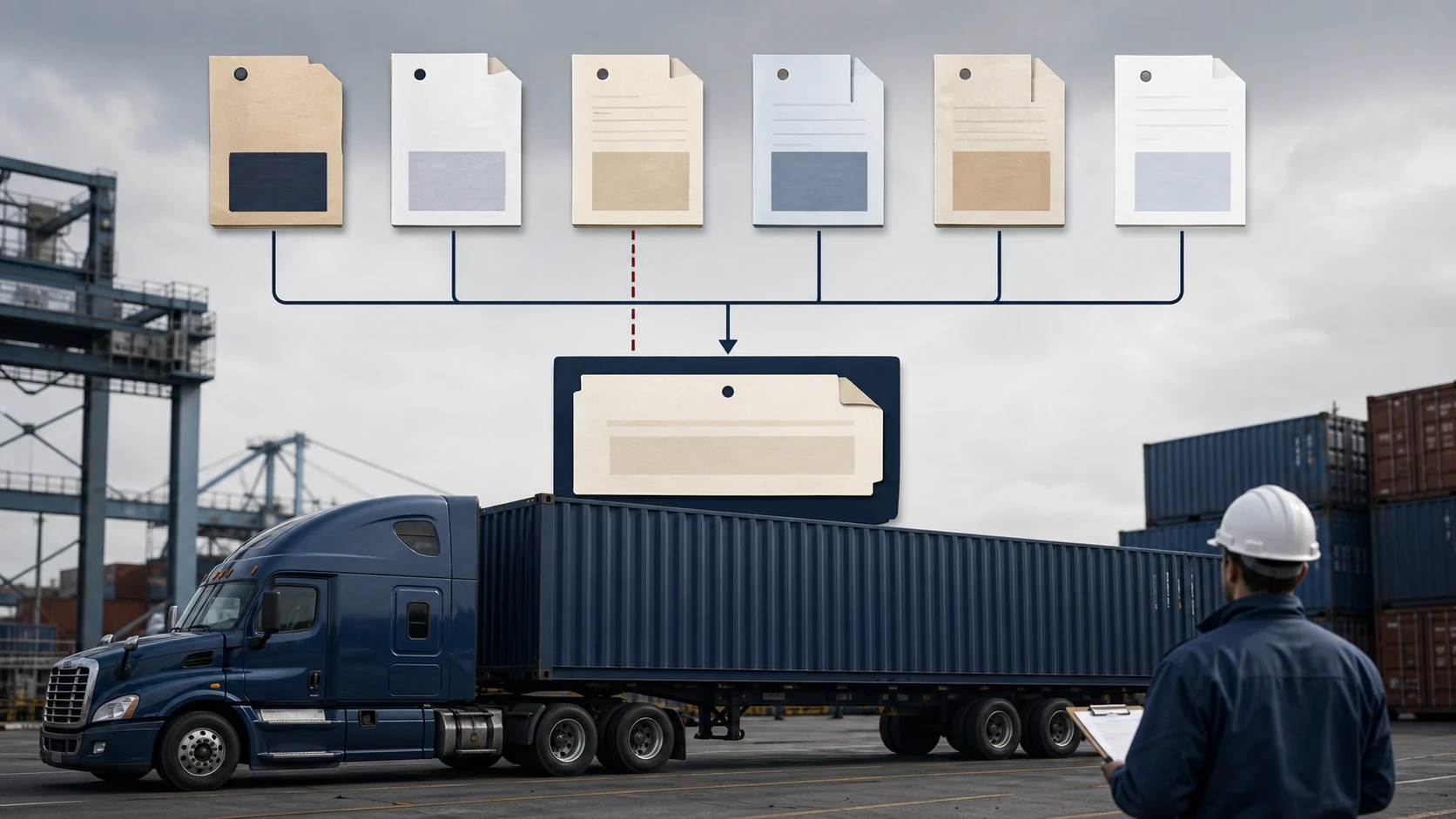
Master agreements, shipment tenders, tariffs, carrier rules, bills of lading, delivery records, and invoices can conflict. Define who can bind whom, which terms are incorporated, and which record governs each issue before freight moves.
The claim arrives after a loss, but the governing-document problem began months earlier.
Procurement signed a master transportation agreement. A rate confirmation incorporated “carrier tariff.” The bill of lading linked to a different set of rules. The carrier's website changed. The invoice cited a new item number. A driver signed the BOL, and someone now argues that the signature accepted every term printed on its reverse.
There is no responsible universal answer that the master agreement, tariff, rate confirmation, or bill of lading always wins. The result can depend on:
- the parties to each document;
- the role in which each party acted;
- mode, commodity, and route;
- contract language and governing law;
- incorporation, notice, assent, authority, and timing;
- negotiated statutory waivers;
- whether the issue is price, service, cargo facts, liability, payment, or evidence;
- what actually occurred.
The practical rule is:
Build the contract stack by relationship, expressly define precedence and incorporation, control who can amend it, and preserve the exact version in force when the shipment was accepted.
An order-of-precedence clause is not magic. It cannot override controlling law, bind a stranger, or rescue an unidentified attachment. It can, however, keep routine document conflict from becoming the center of every invoice and cargo dispute.
A freight contract vs. bill of lading question starts with the legal relationship
One physical shipment can sit inside several agreements:
shipper <-> broker or managed transportation provider
broker <-> motor carrier
shipper <-> direct motor, rail, ocean, or air carrier
shipper or consignee <-> warehouse, terminal, or transloader
beneficial cargo owner <-> insurer
seller <-> buyer
Each arrow can have its own parties, price, duties, liability allocation, claim process, and incorporated rules.
In a brokered load, the shipper's agreement with the broker does not automatically become the carrier's agreement. The broker-carrier rate does not automatically establish what the shipper owes the broker. The carrier's BOL terms do not automatically amend an unrelated customer contract. Agency, third-party-beneficiary, indemnity, subcontracting, and flow-down provisions may connect the relationships, but those are legal and factual questions—not assumptions.
Start by applying the carrier, broker, forwarder, and 3PL role map. Then create a contract map that identifies:
- each legal entity and operating role;
- registration and authority where relevant;
- the agreement between each pair;
- approved subcontracting or downstream providers;
- who tenders, accepts, bills, pays, files claims, and controls disposition;
- which terms are required to flow down;
- who may communicate an operational change;
- who may change price, liability, or payment instructions.
A document hierarchy cannot work until the organization knows whose documents it is ranking.
Separate six kinds of records
The names vary, but most transportation files include six functional layers.
1. Master agreement
The master agreement establishes the ongoing relationship. It commonly addresses:
- scope and roles;
- service and tender mechanics;
- rates or rate schedules;
- insurance and compliance;
- cargo liability and claims;
- indemnity;
- subcontracting;
- confidentiality, data, and cybersecurity;
- invoice, audit, dispute, and payment;
- term, termination, law, forum, and dispute resolution;
- incorporation and order of precedence;
- amendment authority.
It should define the process for forming each shipment commitment, not merely say that the parties “will agree on loads.”
2. Amendment, statement of work, or schedule
These records can adapt the master terms for a business unit, mode, lane set, facility, service, or period. They should identify the master agreement and say exactly which provision they supplement or replace.
An annual rate sheet with no parties, effective date, or relationship to the master agreement is a spreadsheet, not a controlled commercial instrument.
3. Shipment-specific quote, rate confirmation, or accepted tender
This layer identifies the particular move: route, dates, equipment, commodity, service, rate, fuel, stops, and accessorial assumptions. It should state whether it can vary the master terms and, if so, which authorized people and acceptance method are required.
A spot quote may intentionally replace a contract lane rate without reopening indemnity or cargo liability. Say that. Otherwise a shipment-level price correction can be recast as an amendment to the entire agreement.
4. Tariff, rules circular, service guide, or schedule
“Tariff” is used loosely in freight. It can mean:
- a tariff that federal law requires to be filed or published for a regulated category;
- an ocean common-carrier tariff in an automated system;
- a privately published motor-carrier rules tariff;
- an LTL rules circular, classification, or accessorial schedule;
- a rail public rate or circular;
- an air-carrier tariff or service guide.
Those are not legally interchangeable. A privately published carrier rules document may matter because a contract or BOL incorporates it, not because it was filed with a federal regulator.
5. Bill of lading, waybill, or receipt
This layer identifies the cargo, origin, destination, instructions, rating facts, and carrier receipt. It may also contain or incorporate contractual terms. Its role varies by mode and form. The BOL, rate confirmation, invoice, and POD guide separates these functions.
6. Execution and settlement records
POD, tracking events, inspection reports, emails, invoices, credits, and claims record performance and settlement. They can be important evidence. They should not silently amend the commercial terms merely because they were created later.
There is no default commercial hierarchy to copy blindly
Organizations often use a structure like this:
- signed amendment;
- master agreement;
- statement of work or mode schedule;
- accepted shipment-specific tender or rate confirmation;
- identified and incorporated tariff or rules;
- bill of lading;
- operational messages;
- invoice.
That list is only a starting design. It contains an immediate problem: a shipment-specific tender may need to control price, lane, and service details while the master agreement controls liability, indemnity, and disputes. A single top-to-bottom ranking can give the wrong answer.
Use issue-specific precedence instead:
| Issue | Suggested governing layer to define | Important reconciliation |
|---|---|---|
| Relationship, roles, compliance, indemnity | master agreement | nonwaivable law, approved schedules |
| Shipment route, dates, equipment, service | accepted tender or rate confirmation | master change controls, approved revisions |
| Shipment-specific price | accepted rate/tender | master pricing rules, effective schedule, fuel and accessorial terms |
| General accessorial rules | identified schedule or tariff | shipment-specific override, trigger evidence |
| Cargo identity and shipping instructions | accepted BOL/tender data | controlled corrections and actual receipt |
| Cargo liability and claim process | master agreement and valid incorporated terms | governing statute, released-value process, mode, BOL |
| Delivery occurrence and condition | POD and execution evidence | origin evidence, BOL, custody records |
| Amount requested | invoice | every layer above plus actual events |
Counsel can then turn that architecture into contract language. Operations can turn it into system rules.
Identify and freeze incorporated terms
“Subject to applicable tariffs” is an invitation to argue.
For every incorporated publication, capture:
- full legal publisher name;
- exact title and identifier;
- version or item number;
- effective date;
- URL or delivery method;
- date provided or made available;
- applicable mode, service, geography, commodity, and charge;
- provisions displaced by negotiated terms;
- process for future changes;
- archived copy or reliable snapshot.
Do not rely only on a live web link. The page visible during a 2028 dispute may not be the document accepted for a 2026 shipment.
Specify whether future amendments apply automatically, after notice, only to new tenders, or only after written acceptance. Consider what happens to in-transit freight and accepted future loads. A unilateral online change should not become an accidental retroactive price or liability amendment.
For general interstate motor property, federal law does not impose one broad filed-tariff regime. 49 U.S.C. § 13702 identifies federal tariff requirements for specified noncontiguous domestic transportation and household-goods movements, with statutory details and exceptions. Meanwhile, 49 U.S.C. § 13710 makes specified legacy ICC tariffs that were on file but no longer required null and void, and requires covered motor carriers, on shipper request, to provide the rate, classification, rules, and practices supporting a rate.
The operational consequence is precise: do not call a motor-carrier PDF “filed law” merely because its title says tariff. Determine whether it is a required tariff, an incorporated contract document, a rate publication, or an internal rule.
Control shipment-specific changes
Contracts fail in execution when everyone can send an instruction but no one knows who can change an obligation.
Define separate authority for:
- operational instructions;
- destination or appointment changes;
- equipment substitutions;
- additional stops or services;
- price and accessorial approval;
- carrier substitution or rebrokering;
- released or declared value;
- claim settlement;
- bank and remittance changes;
- amendments to legal terms.
A receiver may be authorized to direct the driver to door 42 but not to order a billable inside-delivery service. A dispatcher may approve a practical route change but not accept a new cargo-liability limit. A driver may acknowledge freight receipt but lack authority to amend the master agreement.
State the approved channel, required content, and acceptance event. Preserve the offer, version, sender, authorized role, acceptance, time, and resulting cost or service effect.
Electronic assent can be valid. The federal E-SIGN Act generally says a contract, signature, or record may not be denied legal effect solely because it is electronic. It does not make every click authorized or every record enforceable. The statute preserves substantive requirements and emphasizes accurate, accessible, reproducible retention where electronic records satisfy retention duties.
Address motor-contract waivers expressly
For covered motor transportation, 49 U.S.C. § 14101(b) permits a carrier and shipper, other than for the specified household-goods category, to contract for specified services under specified rates and conditions. If they expressly waive in writing rights and remedies under the relevant part, the covered transportation is not subject to the waived rights and remedies. Registration, insurance, and safety-fitness provisions cannot be waived under that subsection.
Do not convert that into boilerplate saying “all federal law waived.” Identify:
- the transportation covered;
- the parties and their statutory roles;
- the specific rights and remedies addressed;
- the substitute contractual remedy;
- claims and limitation consequences;
- nonwaivable requirements;
- whether the language applies to each subcontracted leg.
The applicability and effect of a waiver—especially in brokered, multimodal, exempt, or unusual arrangements—need qualified legal analysis.
Likewise, 49 U.S.C. § 14706 contains the Carmack framework for covered motor carriers and freight forwarders. It addresses receipts or BOLs, liability, value limitations, venue, and minimum claim and suit periods. A BOL limitation should not be treated as valid merely because it is printed. Assent, released-value requirements, incorporated terms, the contract stack, and statutory waiver can matter.
Do not assume the dock signature amended the deal
A BOL signature can evidence freight receipt, shipper information, or delivery. Whether it accepted new legal terms depends on the document, context, authority, notice, and governing law.
Prevent the dispute operationally:
- use approved BOL forms;
- identify the governing master agreement on the BOL;
- state whether BOL terms supplement or are subordinate to negotiated terms;
- prohibit unauthorized handwritten commercial amendments;
- create a controlled process for genuine changes;
- train drivers and dock staff on acknowledgment versus amendment authority;
- preserve both sides, attachments, and electronic terms;
- reject blank or materially incomplete forms where possible.
If a carrier's driver must sign a shipper form to obtain the freight, the system should not later pretend that the driver negotiated an unseen indemnity, venue, or liability regime. Conversely, a shipper should not assume its warehouse form displaced carrier terms without contract analysis.
Mode changes the contract stack
Rail
49 U.S.C. § 10709 permits rail carriers and purchasers of rail services to contract for specified services under specified rates and conditions. The statute says duties for contract service are those specified by the contract and provides the stated remedy structure, while retaining common-carrier obligations for noncontract transportation. Rail contracts, public rates, circulars, waybills, interchanges, and private-car equipment terms need their own hierarchy.
U.S. foreign ocean commerce
46 U.S.C. § 40501 requires covered common carriers and conferences to maintain automated tariffs showing rates, charges, classifications, rules, and practices, subject to statutory exceptions. 46 U.S.C. § 40502 separately provides for ocean service contracts and identifies essential terms. The Federal Maritime Commission's current 46 CFR Part 520 implements automated-tariff requirements.
An ocean service contract, NVOCC bill, ocean-carrier bill, tariff, booking confirmation, and inland carrier agreement can all touch one container. Map the contracting carrier and through movement before borrowing a truckload hierarchy.
Air, warehousing, household goods, and multimodal
Air waybills and carrier tariffs can interact with domestic law or international conventions. Warehouse receipts and storage agreements can implicate enacted state commercial law. Household-goods transportation has detailed federal consumer rules. Through movements can raise difficult questions about which mode's regime applies to which loss.
Create a mode-specific schedule and obtain advice. “Transportation terms” that silently blend truckload, LTL, parcel, rail, ocean, air, and storage are rarely precise enough.
Test the hierarchy before signing
Run realistic conflicts through the proposed documents:
Rate conflict
The master rate sheet says $2,000. An authorized spot confirmation says $2,300. The invoice says $2,450 plus fuel. Which record changes price, and was fuel included?
Detention conflict
The master grants two free hours; a carrier rules publication grants one; the tender says “all-in.” Which term applies, what event starts time, and what evidence is required?
Cargo-liability conflict
The master states one limit; the BOL and tariff state another. Was either waived or incorporated? Was a valid value choice offered and accepted? Which law and mode apply?
Destination change
Receiving asks the driver to unload at another building. Who can approve the service and added cost? Which revision becomes the execution instruction?
Unauthorized carrier substitution
The broker-carrier agreement prohibits rebrokering; a rate confirmation names one carrier; another arrives. Does the load stop? Who verifies and approves an exception? What are the insurance, payment, and claim consequences?
Multimodal loss
The container moves under an ocean bill and separate inland arrangement. Damage is found after delivery. Which documents govern the through route, custody leg, claim deadline, and liability analysis?
If the contract team cannot answer those scenarios from the documents, operations will not answer them at 2 a.m.
Turn precedence into system controls
Contract governance should be executable:
- contract repository with legal parties and mode;
- effective and expiration dates;
- amendment and version chain;
- exact incorporated publications;
- authorized users and acceptance channels;
- rate and rules export to the TMS;
- shipment-level contract and tender IDs;
- hard stop for expired or unidentified terms;
- alerts for conflicting BOL or invoice references;
- archived web publications;
- legal hold and retention;
- dispute record tied to the exact source versions.
The freight audit process should calculate from those controlled terms. The claims process should retrieve the same versions. If audit, claims, procurement, and operations each keep a different “final contract,” the hierarchy exists only on paper.
Operating takeaway
A durable transportation contract stack can answer:
- Which legal relationship is in dispute?
- Which mode and governing regime apply?
- Which document governs this particular issue?
- Which tariff, rules, classification, or schedule was incorporated?
- Which version was effective and available at acceptance?
- Who had authority to make the shipment-specific change?
- What evidence shows acceptance and performance?
- Which nonwaivable requirements or statutory remedies remain?
Define those answers before tender. Preserve the accepted versions. Make operational changes observable. Test the hierarchy against real conflicts.
The goal is not a clause declaring that one document wins everything. It is a contract architecture in which commercial intent, shipment execution, evidence, and settlement remain connected without being confused.
Place that architecture within the broader operator's map of U.S. freight handoffs.
This article provides operational education, not legal advice or contract language. Contract formation, incorporation, precedence, statutory waiver, liability, tariff status, and remedies vary by role, mode, jurisdiction, document, and facts. Transportation counsel should tailor and review material agreements.
Sources and further reading
- 49 U.S.C. § 14101: Motor transportation contracts and written waivers
- 49 U.S.C. § 13702: Tariff requirements for specified motor transportation
- 49 U.S.C. § 13710: Motor-carrier rate information and billing provisions
- 49 U.S.C. § 14706: Motor-carrier and freight-forwarder cargo liability
- 49 U.S.C. § 10709: Rail transportation contracts
- 46 U.S.C. § 40501: Ocean common-carrier tariff requirements
- 46 U.S.C. § 40502: Ocean service contracts
- 46 CFR Part 520: Carrier automated tariffs in U.S. foreign commerce
- 15 U.S.C. § 7001: Electronic records, signatures, and retention