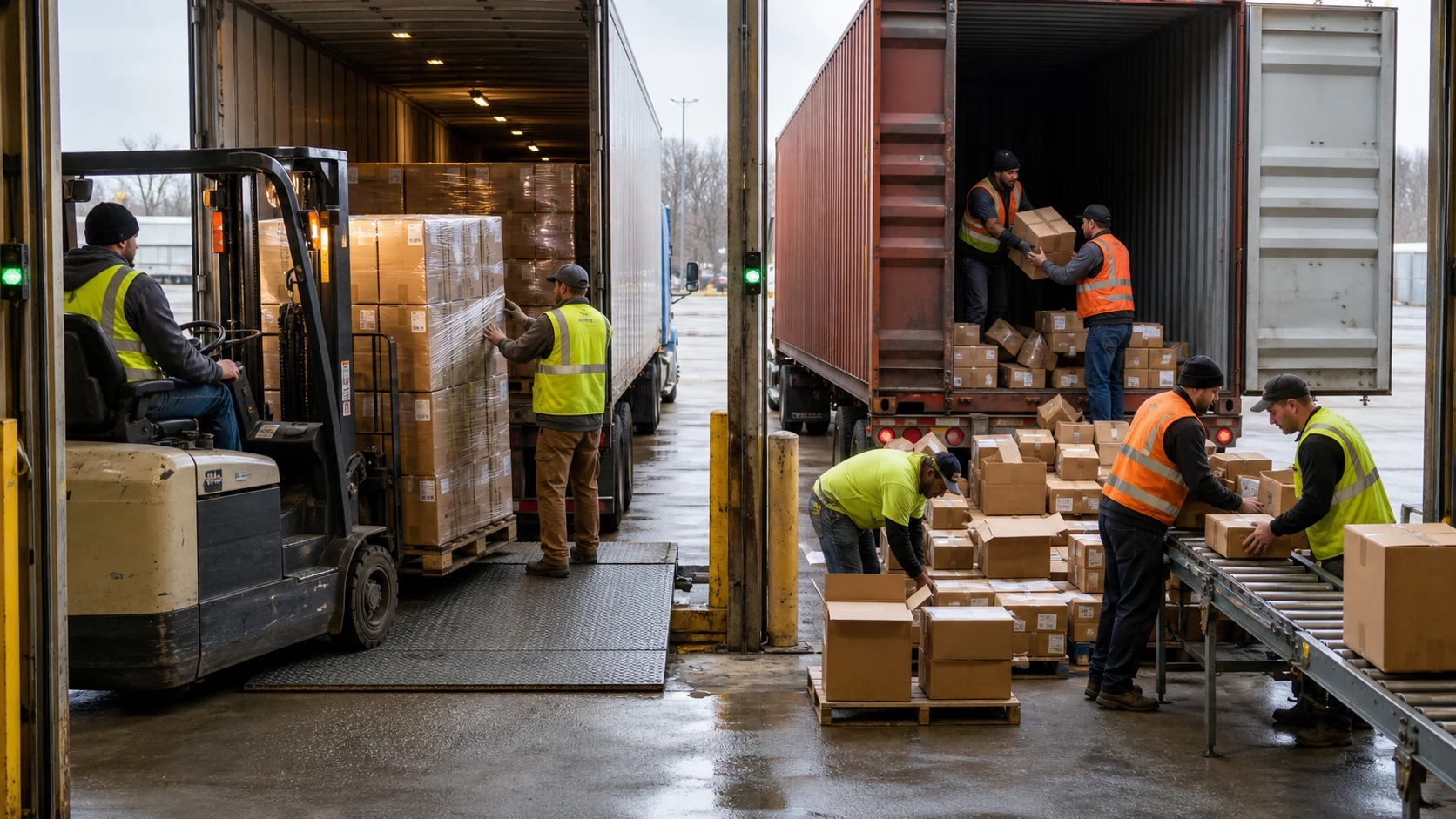
Cross-docking synchronizes inbound and outbound flow; transloading changes equipment, mode, or cargo presentation, and each requires a different control plan.
Cross-docking and transloading are often sold as interchangeable ways to “move freight through a warehouse without storage.” That description is too loose to design an operation or compare providers.
Cross-docking solves a synchronization and sortation problem: receive freight from one or more inbound movements and route it rapidly into planned outbound movements. Transloading solves an equipment or mode problem: transfer cargo from one conveyance or load presentation into another for the next leg. One shipment can require both.
Use one distinction before discussing rates or providers:
Call the operation a cross-dock when its primary job is flow-through allocation across inbound and outbound orders or destinations. Call it a transload when its primary job is changing equipment, mode, packaging, or load configuration for continued movement. Then contract the actual tasks, because the label does not allocate custody or liability.
The distinction determines data, building layout, labor, equipment, evidence, and failure recovery. It also prevents a quote for simple pallet transfer from being compared with a quote that includes container stripping, count, sortation, palletization, labeling, securement, and outbound load construction.
Cross-docking vs. transloading at a glance
These are operating conventions, not universal contractual definitions. The parties should define the work in the service agreement and operating procedure.
| Dimension | Cross-docking | Transloading |
|---|---|---|
| Primary objective | Synchronize and route freight through a node | Change conveyance, mode, equipment, or cargo presentation |
| Typical inbound-outbound relationship | Many-to-many, one-to-many, or many-to-one allocation | One equipment unit to one or more different outbound units |
| Inventory identity | Usually maintained through rapid sort and allocation | May be reconfigured through stripping, palletizing, repacking, or load building |
| Storage expectation | Short, controlled staging tied to an outbound plan | Short staging is common; longer holds may arise from release, capacity, or exception |
| Critical data | Destination, wave, route, handling-unit identity, cutoff | Equipment, dimensions, weight, packaging, condition, seal, customs or regulatory status |
| Main failure | Missed connection, mis-sort, unplanned dwell | Damage, shortage, contamination, weight or securement error, release failure |
| Facility priority | Door synchronization, sort lanes, scan accuracy | Equipment compatibility, handling method, staging, packaging, load construction |
The Federal Highway Administration's freight glossary describes transloading in an intermodal context as transferring bulk shipments from the vehicle or container of one mode to another at a terminal interchange. In port supply chains, the term also commonly covers stripping cargo from an international marine container and loading it into domestic trailers or 53-foot containers, potentially with sorting, labeling, or repackaging. A Port of Los Angeles project document, for example, uses “transloaded” for import cargo moved into domestic rail containers or trucks. That official port source is useful operating context, not a universal legal definition.
A shipment can do both
Consider a 40-foot import container with floor-loaded cartons for eight inland distribution centers. A near-port facility may:
- verify the inbound container and seal;
- strip the cartons;
- sort by purchase order and destination;
- palletize and label;
- allocate pallets to outbound routes;
- load two 53-foot domestic trailers;
- seal and release those trailers.
Changing from international container equipment to domestic trailers is a transload function. Sorting the cargo into synchronized destination movements is a cross-dock function. Pricing it as “one transload” without a detailed work specification hides most of the labor and control risk.
Design a cross-dock around connection logic
A cross-dock is a physical transfer controlled by an outbound plan. Before the first inbound truck arrives, the operator should know which handling units belong to which destination, when each outbound wave closes, and what happens to freight that cannot make its planned connection.
The control record needs:
- inbound shipment, supplier, carrier, trailer, seal, and appointment;
- expected handling-unit or item identifiers;
- destination, route, customer, order, or store allocation;
- inbound door and planned outbound door or sort lane;
- required arrival, wave cutoff, and departure times;
- handling, temperature, segregation, and security rules;
- shortage, overage, damage, and unidentified-freight dispositions;
- permitted staging location and maximum stage time;
- outbound equipment, carrier, load sequence, and seal.
Do not begin receiving against a spreadsheet that maps only purchase orders to destinations when the floor needs carton, pallet, or case-level decisions. The data granularity must match the physical sort.
Protect the outbound cutoff
The cross-dock schedule should work backward from departure:
outbound departure − close and securement − load time − final reconciliation − sort time − unload time = latest viable inbound door time
This is not a promise that every inbound can connect. It exposes when it cannot. Set a freeze point for each outbound wave and name the person who may hold a departure. That decision should weigh the late freight's service importance against driver time, downstream appointments, hours of service, and every order already loaded.
A missed connection needs a predetermined branch:
- move on the next scheduled route;
- expedite directly;
- hold in a defined exception zone;
- return or reject under authorized instruction;
- split the order with controlled partial-shipment status.
If the facility has no miss lane, late or unidentified freight will occupy a sort lane and disrupt loads that are still executable.
Cap staging as a control, not a slogan
“No storage” is rarely literal. Cross-docks stage freight between receipt and departure. Define maximum quantity and time by zone, then create an exception when either limit is exceeded.
Staging controls should prevent:
- freight from different destinations mixing;
- unscanned units entering an outbound lane;
- food, chemical, hazmat, allergen, or temperature-incompatible freight sharing space;
- damaged or held freight reentering normal flow;
- rush freight bypassing count and condition checks;
- an outbound trailer being closed before expected units are reconciled.
The operator should report dwell by handling unit and cause, not merely trailer gate time.
Design a transload around cargo and equipment compatibility
Transloading begins with the physical facts. What is inside the inbound equipment, how is it presented, what will handle it, and what must the outbound equipment safely carry?
The pre-arrival data pack should include:
- inbound and outbound equipment dimensions and restrictions;
- commodity, package type, piece and pallet counts;
- gross and, where required, unit-level weight;
- floor-loaded, palletized, slip-sheeted, rolled, bulk, or oversized presentation;
- center-of-gravity or concentrated-load concerns;
- loading pattern, bracing, dunnage, and securement expectations;
- temperature, sanitation, ventilation, odor, moisture, and contamination restrictions;
- dangerous-goods, food, bonded, or other regulated status;
- inbound seal, customs or release status, and authority to open;
- required pallet type, labeling, relabeling, repacking, inspection, sampling, or value-added work;
- outbound mode, route, delivery constraints, and load sequence.
Never accept “one container, consumer goods” as a work description. The operator cannot price labor, equipment, supplies, door time, or damage exposure from that.
Cube gain is not automatically a cost gain
Import transloading can improve domestic equipment utilization: cargo from smaller international containers may be combined into 53-foot domestic equipment, and imports can be allocated closer to demand. The saving must be tested against:
- drayage to the transload site;
- terminal, chassis, and equipment clocks;
- container stripping and outbound loading;
- pallets, wrap, labels, dunnage, and disposal;
- sortation and inventory-system work;
- added handling damage and shortage exposure;
- facility dwell and storage;
- outbound imbalance or partial equipment;
- exception, rework, and expedite cost.
Use the drayage operating guide to model the port or rail handoff and the FTL, LTL, and partial-truckload framework to choose the resulting domestic mode. A better cube ratio is not useful if the transfer causes a missed last free day, a short shipment, or an outbound axle-weight problem.
Build one custody and evidence chain
Every transfer creates a moment when freight can be lost, damaged, misidentified, contaminated, or attributed to the wrong party. The facility record should be detailed enough to reconstruct the shipment without relying on memory.
At inbound receipt, preserve:
- equipment and seal identifiers;
- arrival, check-in, door, seal-break, and unload times;
- who verified and who authorized the seal break;
- exterior and interior equipment condition;
- visible load condition before disturbance;
- count method and expected source record;
- photographs tied to shipment and time;
- shortage, overage, damage, wetness, shift, odor, infestation, or temperature exception;
- immediate notice and disposition owner.
During handling, record each controlled transformation: pallet built, carton relabeled, unit split, order reallocated, packaging changed, sample removed, freight placed on hold, or scrap authorized. Keep original and new identifiers linked.
At outbound release, preserve:
- carrier, tractor, trailer or container, and driver identity;
- handling units and orders loaded;
- outbound count and reconciliation;
- load sequence, weight, and any securement record;
- trailer condition;
- seal and application time;
- documents released;
- departure time and destination.
The GS1 Logistic Label Guideline provides a standardized method for identifying logistics units with an SSCC and linking the physical unit to electronic data. It does not replace counts, condition evidence, equipment IDs, or seals. It helps keep identity intact while the physical arrangement changes.
If loss or damage emerges, feed this operating file into a disciplined freight-claims process. Do not make the claims team reverse-engineer custody from invoices and text messages.
Facility readiness is specific to the work
A useful provider review should inspect:
Physical capability
- doors compatible with inbound and outbound equipment;
- legal yard capacity and gate process;
- adequate floor load rating, clear height, lighting, weather protection, and security;
- forklifts, clamps, slip-sheet attachments, conveyors, scales, ramps, and dockboards suited to the cargo;
- safe support and restraint for coupled and uncoupled trailers;
- separate normal, exception, hold, damage, and regulated-material zones;
- packaging, pallet, dunnage, waste, and rework space.
Operating capability
- work instructions by commodity and presentation;
- labor plan matched to inbound and outbound peaks;
- appointment and door plan;
- handling-unit scan and reconciliation controls;
- seal control;
- inventory and exception ownership;
- backup plan for equipment, system, labor, or outbound-carrier failure;
- documented training and quality checks.
OSHA's powered-industrial-truck requirements and dockboard requirements are relevant federal baselines for common warehouse equipment and dock operations. They do not constitute a complete facility safety plan. The operator must evaluate its hazards, equipment, cargo, and other applicable rules.
Use the warehouse and 3PL selection framework to move beyond claimed capabilities and test real scenarios. Candidate discovery can begin with UniteCargo's warehouse listings and 3PL listings, but qualification should happen against the exact task and lane.
Resolve regulatory status before opening or transferring freight
The ordinary logistics meaning of transloading is not the definition used in every regulation.
Hazardous materials
Under the Hazardous Materials Regulations, “transloading” has a specific scope involving transfer between bulk and non-bulk packagings for continued movement. A PHMSA interpretation on hazardous-material transloading also explains that pure transfer differs from mixing, blending, or otherwise altering the material. Do not apply the broad warehouse label to decide whether a hazardous-material function falls within or outside federal regulation.
Map shipper, offeror, carrier, and facility responsibilities using the specific material, packaging, mode, shipping papers, through-movement, and function. The separate hazmat responsibility map provides an operating starting point. Qualified dangerous-goods personnel and counsel should review the actual operation.
Customs-controlled cargo
A marine container arriving at a transload site may still move under bond or another customs-control condition. Confirm CBP release, in-bond status, carrier release, seal authority, destination, and any government hold before opening or diverting it. 19 CFR § 18.4 contains specific rules for sealing conveyances and transferring bonded merchandise in covered circumstances.
The customs broker, bonded carrier, forwarder, warehouse, drayage provider, and importer do not become interchangeable because the freight reached a building. The U.S. import handoff guide separates those roles.
Food and temperature-controlled freight
For covered human and animal food, the FDA's Sanitary Transportation rule overview identifies requirements involving shippers, loaders, carriers, and receivers, including vehicle condition and temperature-control practices in scope. A transfer adds doors-open time, equipment, surfaces, and custody events. Product requirements should determine sanitation, segregation, dwell, temperature, and evidence.
Use the product-first cold-chain framework when condition depends on more than a reefer setpoint.
This article is operational education, not legal, customs, food-safety, hazardous-materials, or workplace-safety advice.
Contract the transformation
The scope of work should list each physical and data task:
- receive and verify;
- unload or strip;
- count at specified unit;
- inspect to specified standard;
- sort or allocate;
- palletize, repalletize, label, relabel, wrap, or repackage;
- weigh or measure;
- stage under defined conditions;
- load and sequence;
- secure, seal, document, and release;
- handle shortage, overage, damage, hold, rejection, or missed connection;
- store beyond planned dwell;
- dispose of dunnage, pallets, packaging, or waste.
For each task, state the owner, unit of charge, service standard, evidence, included supplies, exception approval, and liability terms. Identify which contract, warehouse receipt, bill of lading, tariff, or other document applies to each role and period. Counsel should review material terms and any regulated operation.
Avoid a rate sheet that says only “transload: per container.” It invites later disagreement over floor loads, counts, labels, pallet materials, after-hours work, storage, and exception labor.
Score the operation by what it is supposed to accomplish
For cross-docking, measure:
- inbound on-time and data-ready rate;
- handling units received as expected;
- scan and sort accuracy;
- planned connection success;
- handling-unit dwell;
- missed-connection reason;
- outbound departure performance;
- shortages, damages, and misroutes;
- exception units and aging.
For transloading, measure:
- equipment turn time;
- units and weight transferred;
- labor and supplies per unit;
- outbound cube and weight utilization;
- count accuracy;
- damage, shortage, and rework;
- hold and storage time;
- seal and document exceptions;
- total landed transfer cost and downstream service.
Where the same operation performs both, preserve both scorecards. A high outbound cube ratio can coexist with poor order allocation; a fast cross-dock connection can coexist with unacceptable handling damage.
Buy the handoff, not the label
Do not buy a label. Buy a controlled physical transformation.
Cross-docking succeeds when inbound data, sortation, staging, and outbound departures remain synchronized. Transloading succeeds when cargo, equipment, packaging, release status, and the next mode remain compatible. When a shipment requires both, the handoff record must survive both.
Place the facility inside the broader operator's map of how freight moves across America, then test its exact role, custody, clocks, and failure recovery before moving volume.
Sources and further reading
- FHWA Freight Management and Operations: Freight Glossary
- Port of Los Angeles: Everport Container Terminal Improvements Draft EIS/EIR, Chapter 1
- PHMSA: Interpretation CHI-10-004 on hazardous-material transloading
- Legal Information Institute: 19 CFR 18.4, sealing and transfer of bonded merchandise
- FDA: FSMA Final Rule on Sanitary Transportation of Human and Animal Food
- OSHA: 29 CFR 1910.178, Powered Industrial Trucks
- OSHA: 29 CFR 1910.26, Dockboards
- GS1: Logistic Label Guideline