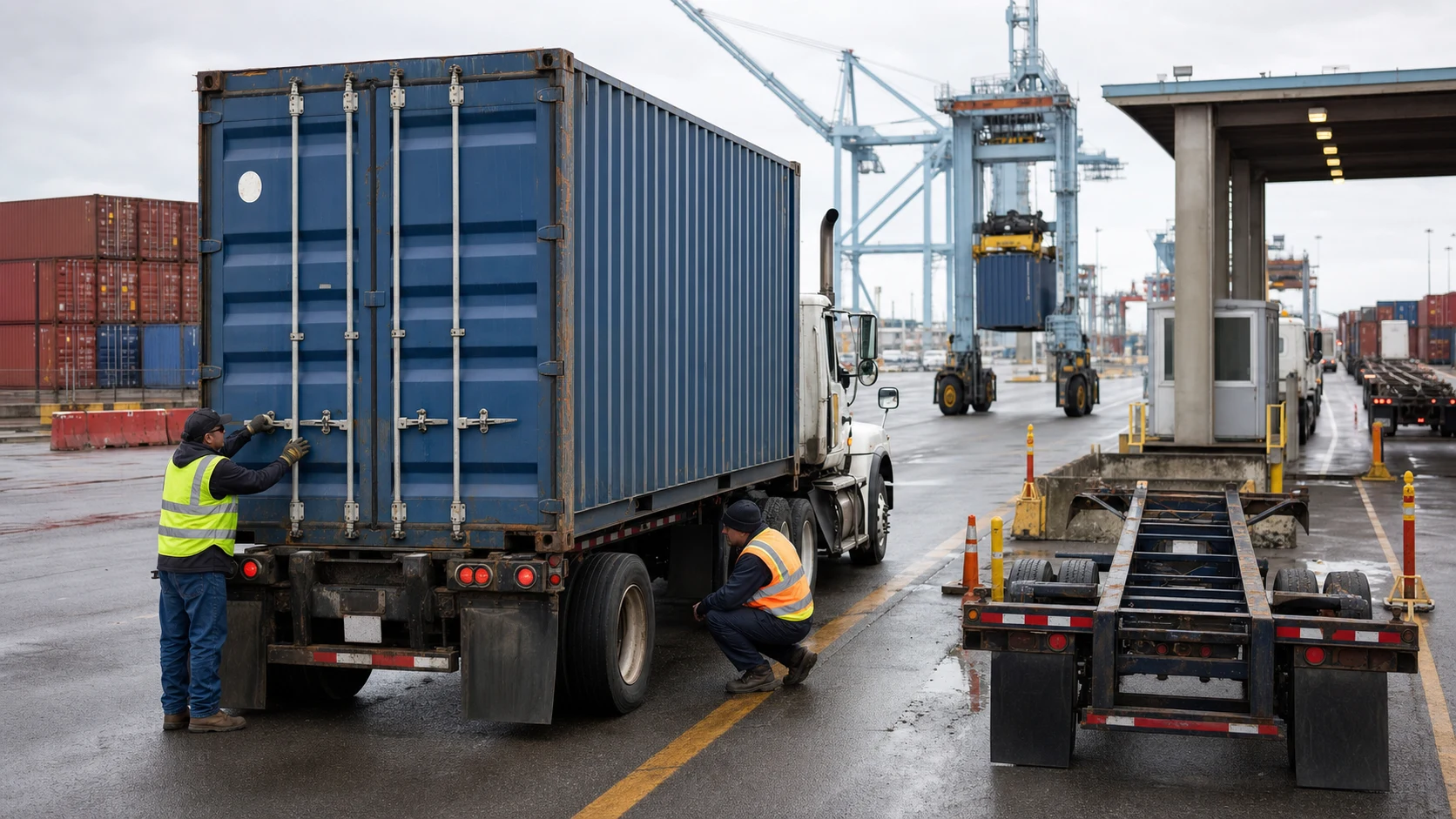
An operator's map of container releases, appointments, chassis, free-time clocks, delivery, and empty return across U.S. port and rail drayage.
Drayage is a short road movement wrapped around a dense stack of dependencies. A container may travel only 25 miles from a marine terminal to a warehouse, yet the move can require an ocean-carrier release, customs and agency clearance, terminal availability, a valid appointment, an eligible driver and motor carrier, a roadworthy chassis, a receiver ready to unload, and an authorized location willing to take the empty.
When those conditions are managed as one vague status—“container at port”—charges accumulate faster than useful answers.
How drayage works: a release-and-return process
To understand how drayage works, track eight distinct gates:
- The shipment and container data are correct.
- Every required commercial and regulatory release is clear.
- The unit is physically available.
- A valid pickup appointment or reservation exists, if required.
- The driver, motor carrier, tractor, and chassis can enter and interchange.
- The container out-gates with condition and time recorded.
- The receiver accepts or unloads it.
- The empty container and any rented chassis are returned to an authorized location, with the interchange closed.
The governing rule is simple:
Never dispatch on vessel arrival, train arrival, discharge, or “customs cleared” alone. Dispatch only when every condition needed for that specific gate transaction is confirmed against the current source of truth.
Port and rail operations differ by facility, ocean carrier, railroad, equipment provider, and contract. The sequence below is a control model, not a substitute for the applicable tariff, service contract, interchange agreement, terminal rules, or law.
First, identify which drayage move you are running
“Drayage” can describe several jobs:
- marine terminal to consignee;
- shipper to marine terminal for export;
- rail ramp to consignee;
- shipper to rail ramp;
- port or rail ramp to transload, container freight station, or warehouse;
- cross-town transfer between terminals or railroads;
- empty repositioning;
- shuttle between a terminal and an overflow yard.
The movement type determines the documents, releases, equipment, and clocks. An import pickup centers on availability and last free day. An export move adds booking validity, earliest receiving date, cutoff, verified gross mass or other carrier requirements, and the terminal's willingness to receive that specific unit. A rail ramp may use railroad storage and equipment rules rather than marine-terminal terms.
Define the move before quoting it.
For the larger mode-and-handoff context, use the operator's map of how freight moves across America.
The import-container handoff, step by step
1. Build a clean container record before arrival
The operating record should connect:
- master and house bill of lading numbers, where applicable;
- ocean carrier and vessel or rail carrier and train reference;
- container number, size, type, seal, and gross weight;
- port, terminal, rail ramp, and discharge location;
- importer, customs broker, forwarder, and beneficial cargo owner contacts;
- consignee, delivery address, hours, appointment rules, and unload method;
- chassis plan and special equipment;
- hazardous, refrigerated, overweight, out-of-gauge, high-value, or exam conditions;
- free-time source, last free day, and empty-return instructions;
- party authorized to approve storage, pre-pull, yard, redelivery, or other exception cost.
A transposed container number can invalidate an appointment. An incorrect terminal can waste a driver. A missing gross weight can turn a legal standard move into an overweight problem after the box is already mounted.
One person or team should own record integrity. Copying status between portals without reconciling identifiers creates the appearance of visibility while preserving the error.
2. Clear each release independently
An import can have several release gates:
- ocean-freight release: the carrier's commercial hold is clear;
- customs release: CBP permits release from customs custody;
- partner-government-agency status: any FDA, agriculture, environmental, or other agency condition is satisfied;
- terminal release: terminal charges, documentation, or operational holds are clear;
- exam release: any required inspection or exam movement is completed;
- line or equipment release: the container and equipment can be interchanged to the selected motor carrier.
CBP describes the Automated Commercial Environment as the U.S. platform for manifest, cargo-release, post-release, and partner-agency processing. A CBP release is not proof that an ocean-freight, terminal, exam, or no-entry hold is clear. The guide to a clean customs-broker and freight-forwarder import handoff separates importer, broker, forwarder, and carrier responsibilities.
The status board should show each hold separately, with the party able to resolve it. “Not released” is not an escalation. “CBP released; carrier freight hold remains; forwarder awaiting carrier payment posting” is.
3. Confirm physical availability and the controlling clock
Discharged does not mean available. A terminal may still be working the vessel, placing the container, completing an exam transfer, or updating its systems. Conversely, a container can become available before the transportation team notices that its free time has started.
Record:
- actual discharge or deramp event;
- first available date and time;
- source and retrieval time of that status;
- last free day or free-time expiration;
- appointment eligibility;
- all current holds;
- any extension, waiver, or special arrangement and who issued it.
The Port of Virginia's container-event data specification illustrates the required separation: availability, holds, customs release, last free day, appointment estimates, and gate events are distinct data elements. Other terminals expose different systems and definitions. Use the facility and carrier sources applicable to the load.
Do not calculate last free day from an assumed number of days when a carrier or terminal provides the controlling date. Weekends, holidays, terminal closures, service-contract terms, and updates can affect the clock. Save a screenshot, EDI message, API record, or written notice showing what the operator relied on.
4. Secure and validate the appointment
An appointment is not capacity unless it is valid for the motor carrier, driver or truck where required, transaction type, container, terminal, and time window.
Before dispatch, confirm:
- reservation number and status;
- correct import, export, empty, or dual transaction;
- container and booking association;
- driver, tractor, RFID, credential, or license-plate association;
- gate window and grace rules;
- current terminal hours;
- holds or “trouble” status that can invalidate the move;
- empty return or export receiving acceptance for a dual transaction.
Appointment processes change. For example, the Port of Virginia publishes current PRO-PASS reservation and empty-return release information through its operations portal. That is evidence of how one gateway currently manages reservations, not a rule for another terminal. Drayage standard work should link to live facility instructions rather than preserve a stale screenshot as policy.
5. Validate access, chassis, and roadability
Port or ramp access can depend on motor-carrier enrollment, driver credentials, insurance, equipment-provider approval, security credentials, and facility-specific rules. Confirm eligibility before assigning the driver.
The chassis plan must answer:
- Is the container mounted or grounded?
- Who supplies the chassis?
- Where is it picked up?
- Is a split move required between the chassis pool and container terminal?
- Which size, configuration, permits, or genset does the load require?
- Who pays chassis use, split, flip, stop-off, or bad-order time?
- What happens if the assigned chassis is unavailable or rejected?
Chassis roadability is a safety control, not an appointment inconvenience. FMCSA's intermodal-equipment-provider requirements require covered providers to register, systematically inspect and maintain equipment, support driver pre-trip inspections, and repair or replace reported deficient equipment before departure. FMCSA also identifies the components a driver must inspect before transporting intermodal equipment, including readily visible brake components, lights, tires, coupling devices, frames, locking pins, and related components.
The driver should report defects through the facility's process and retain the transaction evidence. Dispatch should record whether the result was repair, chassis replacement, flip, or failed move, because that event may drive both safety follow-up and commercial charges.
6. Capture the out-gate interchange
At out-gate, collect:
- container and chassis identity;
- date, time, and facility;
- seal number and visible condition;
- damage or defect notation;
- photographs where permitted and useful;
- equipment interchange receipt or electronic equivalent;
- gross or scale weight where required;
- driver and tractor reference;
- start of any container, chassis, or equipment-use period.
The Uniform Intermodal Interchange and Facilities Access Agreement is the principal standard industry agreement governing equipment interchange between participating motor carriers and equipment providers, supplemented by provider addenda and bilateral terms. It does not replace the need to preserve the actual interchange record. The EIR is often the strongest evidence of when possession began and what condition was visible.
7. Design the delivery before the box leaves the terminal
Confirm whether the receiver will:
- live unload;
- accept a drop container;
- accept the chassis as well as the box;
- transload and release the empty the same day;
- require a delivery appointment, reference, seal check, temperature record, or pallet count;
- handle an overweight or floor-loaded container;
- operate during the driver’s feasible arrival window.
A “drop” solves receiver dwell by transferring equipment time to the yard or consignee. It is only advantageous when the shipper understands container and chassis free time, has secure space, can unload promptly, and can coordinate empty return.
For a live unload, the dray contract should define free waiting time, detention increments, notification, proof, and stop-work authority. Those truck-waiting terms are commercial motor-carrier accessorials and should not be confused automatically with ocean-container detention.
8. Treat empty return as a second terminal move
The job is not complete when cargo is delivered. The empty container may have:
- a designated return terminal, depot, or rail ramp;
- a return location that changes by date or equipment provider;
- a no-entry restriction;
- a separate appointment;
- restrictions on dual transactions;
- condition, cleanliness, placard, or residue requirements;
- an equipment-use clock still running.
Confirm the authorized return location on the day of dispatch and retain the instruction. After return, capture the in-gate interchange, date and time, condition, and end of chassis or container use. Reconcile the returned container number—not merely the load number—to the provider's equipment ledger.
An unrecorded return can become days of per diem. A return to an unauthorized location can create another move. A rejected empty without evidence can become an invoice dispute no one can reconstruct.
Separate the clocks before the charges begin
The labels vary by mode and contract, so start with the asset, location, charging party, and governing rule.
| Clock or charge | Operational event commonly behind it | Evidence to retain |
|---|---|---|
| Marine-terminal demurrage or storage | Loaded container remains at a terminal beyond allowed free time | Availability, free-time terms, last free day, holds, appointments, gate and closure records |
| Ocean-container detention or per diem | Container remains outside the terminal beyond allowed equipment time | Out-gate and empty-return EIRs, return instructions, rejection or no-entry evidence |
| Chassis use or rental | Chassis remains in the motor carrier's or customer's use | Chassis interchange, provider terms, split or flip records, return receipt |
| Rail storage | Unit remains at a rail facility beyond railroad free time | Deramp or availability event, notification, holds, appointment attempts, out-gate |
| Truck detention or waiting time | Driver or tractor waits at shipper, consignee, terminal, or other stop under motor-carrier terms | Arrival, check-in, release, geofence, signed times, messages |
| Pre-pull or yard storage | Container is removed before delivery and held in an off-terminal yard | Authorization, yard in/out events, daily rate, reason for pre-pull |
Do not rely on the label printed on the invoice. Test the actual event and the applicable tariff, service contract, terminal schedule, interchange addendum, or rate confirmation. The guide to detention, demurrage, per diem, and storage goes deeper into charge ownership and evidence.
The current FMC billing rules: what operators should verify
Regulatory snapshot reviewed July 27, 2026. This section is operational education, not legal advice.
46 CFR Part 541 governs covered demurrage and detention invoices issued by ocean common carriers, marine terminal operators, and non-vessel-operating common carriers. The rule requires specified identifying, timing, rate, dispute, and certification information. It generally requires invoices within 30 calendar days after the charge was last incurred, with a different timing formulation for an NVOCC passing through an invoice, and gives the billed party at least 30 calendar days from invoice issuance to request mitigation, refund, or waiver.
One material point changed after the rule was issued. In September 2025, the D.C. Circuit set aside the billed-party limitation in 46 CFR § 541.4 while leaving the rest of the rule in place. The FMC confirmed in June 2026 that it is revisiting that issue and that the other provisions remain in effect.
Operators should therefore avoid old summaries stating categorically who may or may not be billed. Validate the current regulation, governing agreement, invoice basis, and legal position for the transaction.
The FMC's 2026 discussion of the Evergreen matter also confirms that reasonableness can turn on practical ability to return equipment: the D.C. Circuit upheld the Commission's decision concerning charges during a port closure. That does not mean every closure automatically defeats every charge. Preserve facility hours, rejected appointments, no-entry messages, return instructions, and communications so the specific facts can be evaluated.
If a covered ocean-common-carrier charge appears noncompliant, the FMC provides a charge-complaint process and evidence guidance. Escalate within contractual deadlines; do not ignore an invoice because one field appears deficient.
Build a daily drayage control board
One row per container should show:
| Control | Required field |
|---|---|
| Identity | Load, bill of lading, booking, container, size/type, seal |
| Location | Port, terminal or ramp, current physical status |
| Releases | Ocean-freight, CBP, partner agency, terminal, exam, equipment |
| Clocks | Available date, last free day, container free time, chassis time |
| Pickup | Appointment number/status, carrier, driver, tractor, chassis plan |
| Delivery | Consignee appointment, live/drop, unload capability, latest delivery |
| Return | Current authorized empty location, appointment, return deadline |
| Evidence | Status source/time, EIRs, screenshots, photos, timestamps |
| Exception | Blocked condition, responsible party, next action, escalation time |
| Cost authority | Person authorized to approve pre-pull, storage, redelivery, or premium action |
Color should reflect the next executable gate, not a general feeling about the load. A container with customs release but no terminal availability is not green. A container available on last free day with no appointment is an immediate exception.
Quote and hand off the move with enough detail
A drayage request should include:
- import, export, rail, port, cross-town, or empty movement type;
- terminal or ramp and ocean or rail carrier;
- container size, type, gross weight, and commodity constraints;
- mounted or grounded status and chassis responsibility;
- all known release and appointment requirements;
- pickup availability and last free day;
- delivery location, appointment, live/drop plan, and unload time;
- empty-return plan;
- permits, overweight route, genset, reefer, hazmat, exam, or security needs;
- free time and rates for truck waiting, chassis, storage, pre-pull, split, flip, redelivery, and dry run;
- proof requirements and escalation contacts.
The dray carrier should return the assumptions with the quote. “All-in” is meaningful only when the scope and exclusions are written.
You can identify relevant trucking companies in the UniteCargo directory, but provider selection should test terminal experience, interchange access, insurance, chassis model, appointment process, driver capacity, evidence quality, and exception coverage for the specific gateway.
Operating takeaway
Drayage is controlled when the team can prove five things at any moment: the container's identity, its releases, the clock, the next executable event, and the party capable of clearing an exception.
Manage pickup and empty return as one closed loop. Separate every release. Treat availability, appointments, chassis, delivery, and return as independent gates. Preserve the EIRs and the failed-attempt evidence. The road miles may be short; the control chain is not.
Sources and further reading
- eCFR — 46 CFR Part 541, Demurrage and Detention
- D.C. Circuit — World Shipping Council v. FMC, No. 24-1088 (2025)
- Federal Maritime Commission — June 2026 Testimony on Current Rule and Litigation Status
- Federal Maritime Commission — Charge Complaint Guidance
- Federal Maritime Commission — Detention Fees and Freight Fluidity, July 2026
- FMCSA — Intermodal Equipment Providers
- FMCSA — Driver Responsibility for Intermodal Equipment
- IANA — Uniform Intermodal Interchange and Facilities Access Agreement
- U.S. Customs and Border Protection — How to Use ACE
- Port of Virginia — Operations Portal and PRO-PASS