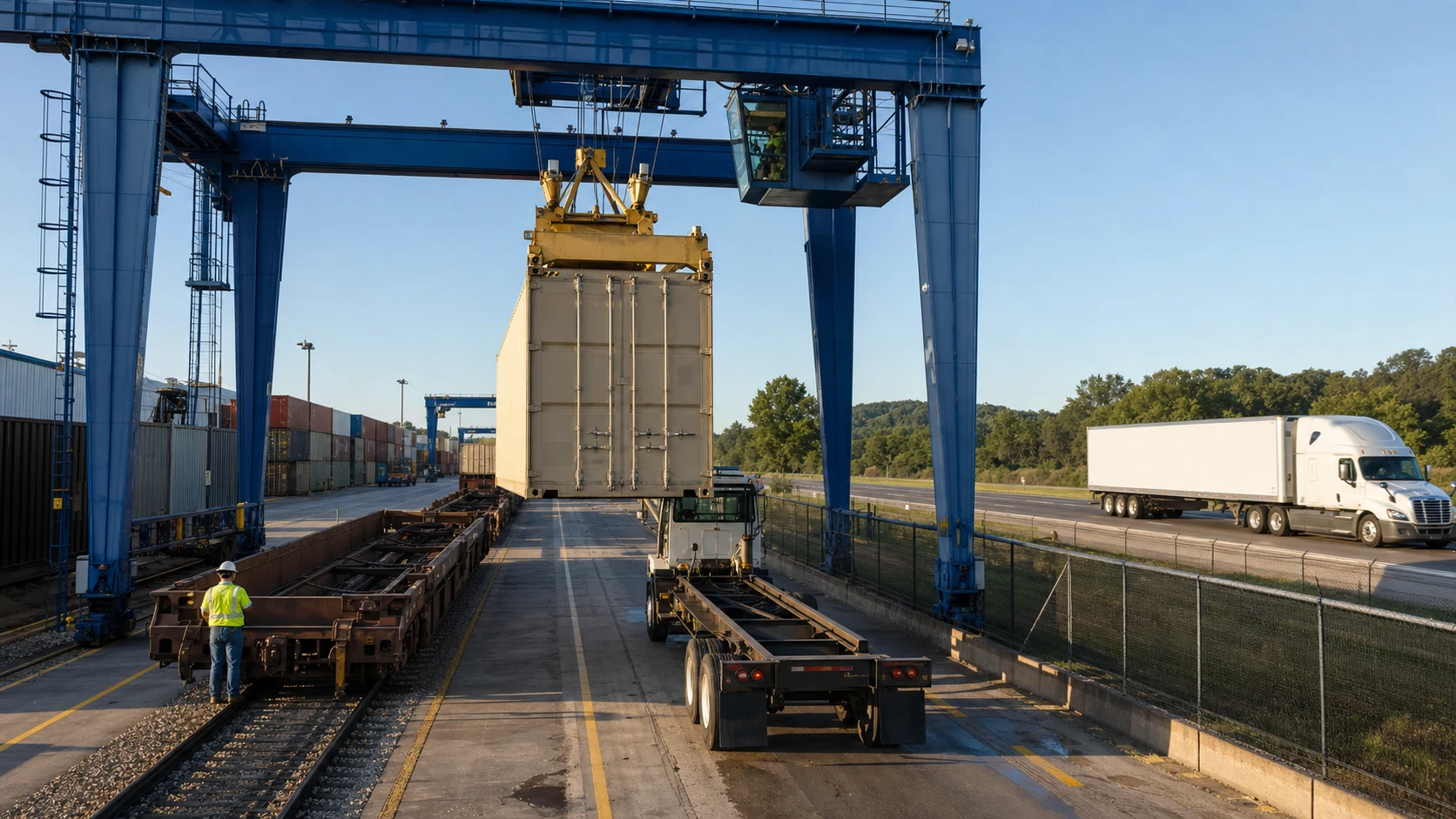
A door-to-door framework for deciding when rail intermodal savings survive drayage, terminal handling, inventory, and exception costs.
Rail intermodal can lower linehaul cost and freight emissions on the right lane. It can also move a shipper's risk from the highway into two dray moves, two terminal handoffs, equipment dependencies, cutoffs, storage clocks, and a slower recovery path.
The decision is therefore not “rail or truck?” It is whether a specific origin-to-destination corridor, shipment profile, and service requirement can support an intermodal operating plan better than a truckload operating plan.
The short answer
Choose intermodal over truckload only when all four conditions are true:
- Origin and destination can support reliable drayage to the relevant ramps.
- The product, loading pattern, and delivery promise can tolerate the intermodal path.
- The door-to-door savings remain after every dray, lift, equipment, terminal, inventory, and exception cost is included.
- The provider can show a credible service history and recovery plan for that exact corridor.
There is no universal mileage threshold that answers the question. Distance helps create rail linehaul economics, but terminal geography, lane balance, train service, dray capacity, fuel, equipment, volume, and schedule can reverse a rule of thumb. Use corridor evidence.
Intermodal vs. truckload starts with the operating path
In a typical domestic intermodal move, freight is loaded into a container at or near the shipper, drayed by truck to an origin rail ramp, lifted onto a railcar, moved by train, lifted or grounded at a destination ramp, and drayed to the receiver. The freight generally stays inside the same container through the rail transfer.
That is different from traditional rail carload service, where the railcar itself is the freight equipment, and from transloading, where the goods are physically transferred between an ocean container, domestic container, trailer, or warehouse.
Those first and last road legs deserve their own operating design. The drayage guide maps appointments, chassis, availability, and equipment return at rail and port facilities.
The Intermodal Association of North America defines intermodal as cargo moving in a container or trailer by more than one transportation mode. IANA's intermodal factbook explains the development and use of 53-foot domestic containers, while international moves may remain in ISO ocean containers or be transloaded. Equipment, permissible cargo weight, loading instructions, and service design vary by provider; do not assume a highway-trailer loading plan automatically fits an intermodal container.
The Federal Railroad Administration's freight rail overview explains why rail is structurally attractive for long-distance and heavy freight. The operating trade is that a train linehaul is not a door-to-door product by itself. The intermodal product exists only when drayage, ramp handling, rail service, equipment, information, and delivery are joined under a workable control plan.
Start with six conversion gates
An intermodal rate request is premature until the lane passes these gates.
1. Ramp geography
Map road miles and operating time from the actual origin to the origin ramp, and from the destination ramp to the actual consignee. Include:
- urban congestion and restricted routes;
- tolls and port or terminal access requirements;
- driver hours and parking;
- live-load and live-unload dwell;
- empty miles and empty-container positioning;
- appointment availability;
- alternative ramps if the primary terminal is disrupted.
Straight-line distance is irrelevant to a driver. A short dray through a congested urban gate can be less reliable than a longer highway movement. Ask the dray carrier for time-of-day performance and empty-mile assumptions, not just a zone rate.
2. Repeatable volume
Rail economics benefit from repeatable corridor density, but “we ship a lot” is not a lane profile. Build weekly distributions for:
- loads by day and season;
- tender lead time;
- ready-time consistency;
- cancellation rate;
- origin and destination pairs;
- shipment weight and cube;
- special-equipment requirements;
- weekend and holiday behavior.
A lane with ten weekly loads released unpredictably after cutoff may convert worse than a lane with four disciplined loads. Volume should be usable by the operating schedule.
3. Time and variability tolerance
Separate three clocks:
- Requested transit: what procurement asks the provider to quote.
- Operating transit: gate-in through destination availability plus both drays.
- Business tolerance: the latest delivery that avoids real cost.
Truckload typically offers a more direct path and faster exception recovery. Intermodal can still meet the business requirement when orders are planned earlier or delivery windows are wider. That is a supply-chain design decision, not a reason to hide slower or more variable transit.
Use actual door-to-door history by day of week and season. Average transit is not sufficient. Measure the tail: late arrivals, missed cutoffs, grounded-not-available intervals, weekend holds, and hours to recover after service interruption.
4. Cargo and loading fit
Intermodal is not merely a mode change; it is a different ride environment and equipment system. Review:
- legal and provider-specific weight limits;
- weight distribution and container floor loading;
- blocking, bracing, and void management;
- vibration and longitudinal movement;
- temperature needs and power continuity;
- hazardous-material acceptance and documentation;
- high-value, theft-sensitive, fragile, or contamination-sensitive cargo;
- load and unload method;
- compatibility with container dimensions and doors.
The shipper should obtain the provider's current loading and restricted-commodity rules and make them part of the standard work. A successful truckload history does not prove that the same packaging and loading plan is suitable for rail intermodal.
5. Equipment and lane balance
The rate assumes a box is available where the shipper needs it and recoverable where the provider needs it next. Test:
- domestic-container supply by market;
- chassis or wheeled-equipment model at both ends;
- drop capacity and free-time terms;
- peak-season positioning;
- empty-return location and timing;
- whether equipment substitution is allowed;
- responsibility for a rejected or defective unit.
Intermodal equipment interchange is commonly governed through the Uniform Intermodal Interchange and Facilities Access Agreement between participating motor carriers and equipment providers, plus provider addenda and commercial agreements. The shipper's door-to-door contract should still identify who manages equipment, charges, and disputes; participation in a standard interchange agreement does not make those costs disappear.
6. Recovery capability
Ask what happens when the planned path fails:
- Can a load missing rail cutoff move on the next departure?
- Can it be converted to truckload without unloading?
- Who has authority to approve a premium recovery?
- Is the container accessible or buried in a terminal stack?
- Can the destination dray carrier recover a unit after a late availability event?
- What happens when the consignee misses delivery or cannot unload?
- Is there an alternate ramp, carrier, or transload option?
An intermodal provider with a lower normal rate but no practical recovery path may be the expensive choice for a critical lane.
Build a true door-to-door cost
Compare the same scope on both modes.
Intermodal expected cost
At minimum, include:
- empty positioning or origin equipment charge;
- origin drayage;
- origin wait time, stop, or failed-attempt risk;
- ramp gate, lift, or terminal charges where not included;
- rail linehaul and fuel treatment;
- destination lift or terminal charge;
- destination drayage;
- chassis, container, storage, and equipment-use exposure;
- delivery waiting time, redelivery, or consignee failure;
- extra pipeline inventory or safety stock;
- expected recovery and exception cost;
- administrative cost of reconciling more operating parties and invoices.
Truckload expected cost
Include:
- linehaul and fuel;
- origin and destination dwell;
- drop-trailer or trailer-pool cost;
- team or expedited service where required;
- layover, redelivery, and extra-stop exposure;
- expected service failure and replacement-capacity cost;
- inventory and administrative cost.
The comparison should use expected values derived from shipment history where possible, not a blanket contingency percentage invented to “cover risk.” The article on how freight rates are calculated provides a broader pricing model.
When equipment or terminal clocks are material, classify them with the separate guide to detention, demurrage, per diem, and storage rather than hiding them in a generic accessorial allowance.
The savings must survive the bad-but-normal week
Run at least three scenarios:
- Normal: expected dray, rail, terminal, and delivery execution.
- Strained: a missed cutoff, one additional day, or constrained destination dray.
- Failure: diversion to truckload, storage plus redelivery, or a missed customer requirement.
Intermodal does not need to win every failure scenario. It does need to fit the business's loss tolerance and preserve enough normal savings to fund realistic exceptions.
Map each handoff and owner
| Handoff | Evidence required | Primary operating owner to define in the contract |
|---|---|---|
| Empty release to origin dray | Container and chassis identity, release number, condition | Equipment provider and origin dray coordinator |
| Arrival at shipper | Arrival time, equipment acceptance or defect, loading start | Shipper and dray carrier |
| Loaded departure | Seal, weight, load condition, departure time | Shipper and dray carrier |
| Origin ramp gate-in | Gate receipt, unit identity, cutoff compliance | Origin dray carrier |
| Rail movement | Waybill or rail billing reference, departure and interchange events | Intermodal provider or railroad |
| Destination availability | Train arrival, grounded or mounted status, actual availability | Intermodal provider and destination ramp |
| Destination out-gate | Equipment interchange record and condition | Destination dray carrier |
| Final delivery | Appointment, arrival, unload, signed exceptions | Dray carrier and consignee |
| Empty return | Valid return location, in-gate receipt, condition, end of use | Dray coordinator and equipment provider |
Actual contractual responsibility can differ. The point is to assign it before a failure, not during one. The operator's map of the U.S. freight system explains the distinction between physical custody, instructional control, commercial responsibility, and regulatory authority.
Do not confuse visibility with control
An intermodal portal may show a train arrived, but the container may not be grounded or available. A dray carrier may have an appointment, but the unit may carry a hold. A delivery ETA may be mathematically possible while the driver lacks remaining hours or the receiver lacks a valid appointment.
Use event definitions with operational meaning:
- tender accepted;
- empty released;
- loading complete;
- origin ramp in-gate;
- rail departed;
- destination arrived;
- available for pickup;
- appointment confirmed;
- destination out-gate;
- delivered;
- empty returned and interchange closed.
Each event should have a timestamp, source, and exception owner. “In transit” is not enough to run a corridor.
The Surface Transportation Board requires Class I railroads to submit weekly rail-service performance reports. Those public network indicators can help operators understand broader conditions, but they do not replace a provider's lane-level shipment history.
Inventory is part of the modal decision
If intermodal adds time or variability, finance and planning need to see the inventory consequence.
Calculate:
- additional average days in transit;
- variability buffer required at the destination;
- value of goods in transit;
- stockout or production consequence;
- obsolescence and damage sensitivity;
- expedited replenishment policy.
Do not reject intermodal automatically because it carries more inventory. Do not claim savings while leaving that inventory outside the business case. A rational conversion may pair lower transport cost with a modest planned buffer. An irrational conversion shifts the rate benefit to transportation and the shortage cost to operations.
Measure emissions with shipment activity, not a slogan
Rail can provide a material emissions advantage, but the comparison should include the whole move. Origin and destination dray miles, empty positioning, payload, carrier performance, and actual rail routing all affect the result.
EPA's SmartWay shipper tools and technical resources support carrier benchmarking and modal-shift analysis. Use actual shipment activity and the most representative carrier factors available. State the boundary: door to door, not rail linehaul versus truck door-to-door.
An emissions estimate is a separate decision input. It should not be used to conceal poor service or double-count an economic benefit that is already embedded elsewhere.
Run a controlled corridor pilot
A useful pilot is designed to disprove the conversion as well as confirm it.
Before launch
- agree on eligible commodities, weights, origins, destinations, and order profiles;
- define cutoff, transit, availability, and delivery events;
- establish primary and recovery routing;
- set rate and accessorial assumptions;
- document loading and securement work;
- connect provider identifiers to the shipper's load number;
- assign exception and spend authority;
- establish a truckload control group.
During the pilot
Track every tender, including rejected and converted loads. Capture quoted and invoiced cost, door-to-door elapsed time, on-time performance against the real customer window, exception type, recovery hours, terminal or equipment charges, claims, and operator touches.
At review
Compare like shipments by release day, corridor, and service requirement. Do not discard failures as “non-representative” unless the same exclusion is applied to truckload. Separate provider setup problems from structural corridor problems, but charge both to the pilot until corrected.
Convert the lane only when the evidence supports repeatable performance. If the result depends on one dispatcher manually rescuing every third load, the process is not yet scalable.
Where the default answer changes
Intermodal deserves a strong presumption when the corridor has good ramp access, repeatable volume, compatible cargo, planned lead time, adequate equipment, and meaningful door-to-door savings.
Truckload deserves a strong presumption when the shipment is highly time-sensitive, the origin or destination is poorly positioned to a ramp, volume is irregular, recovery must be fast, cargo has special handling constraints, or the intermodal savings disappear after inventory and drayage.
A split strategy is often better than an ideological mode decision:
- intermodal for base, planned volume;
- truckload for surge, late release, or high-consequence orders;
- a routing rule that uses shipment attributes rather than account-level preference;
- quarterly lane revalidation as rates, schedules, terminals, and inventory requirements change.
That routing logic should ultimately live in a routing guide with executable fallback rules, not in buyer memory.
Operating takeaway
Intermodal works when rail's linehaul advantage is supported by disciplined first and last miles. Truckload works when the value of directness, flexibility, and recovery exceeds the premium for dedicated road capacity.
Model the actual corridor, expose every handoff, price the whole path, and pilot against a truckload control. If the savings survive terminal reality, inventory, and the normal exception week, intermodal is a network decision. If they survive only on the rate sheet, it is not.
Sources and further reading
- Federal Railroad Administration — Freight Rail Overview
- FHWA and BTS — Freight Analysis Framework
- Intermodal Association of North America — What Is Intermodal?
- IANA — Intermodal Factbook
- IANA — Uniform Intermodal Interchange and Facilities Access Agreement
- Surface Transportation Board — Rail Service Data
- EPA SmartWay — Shipper Tools and Resources
- IANA — Intermodal Glossary