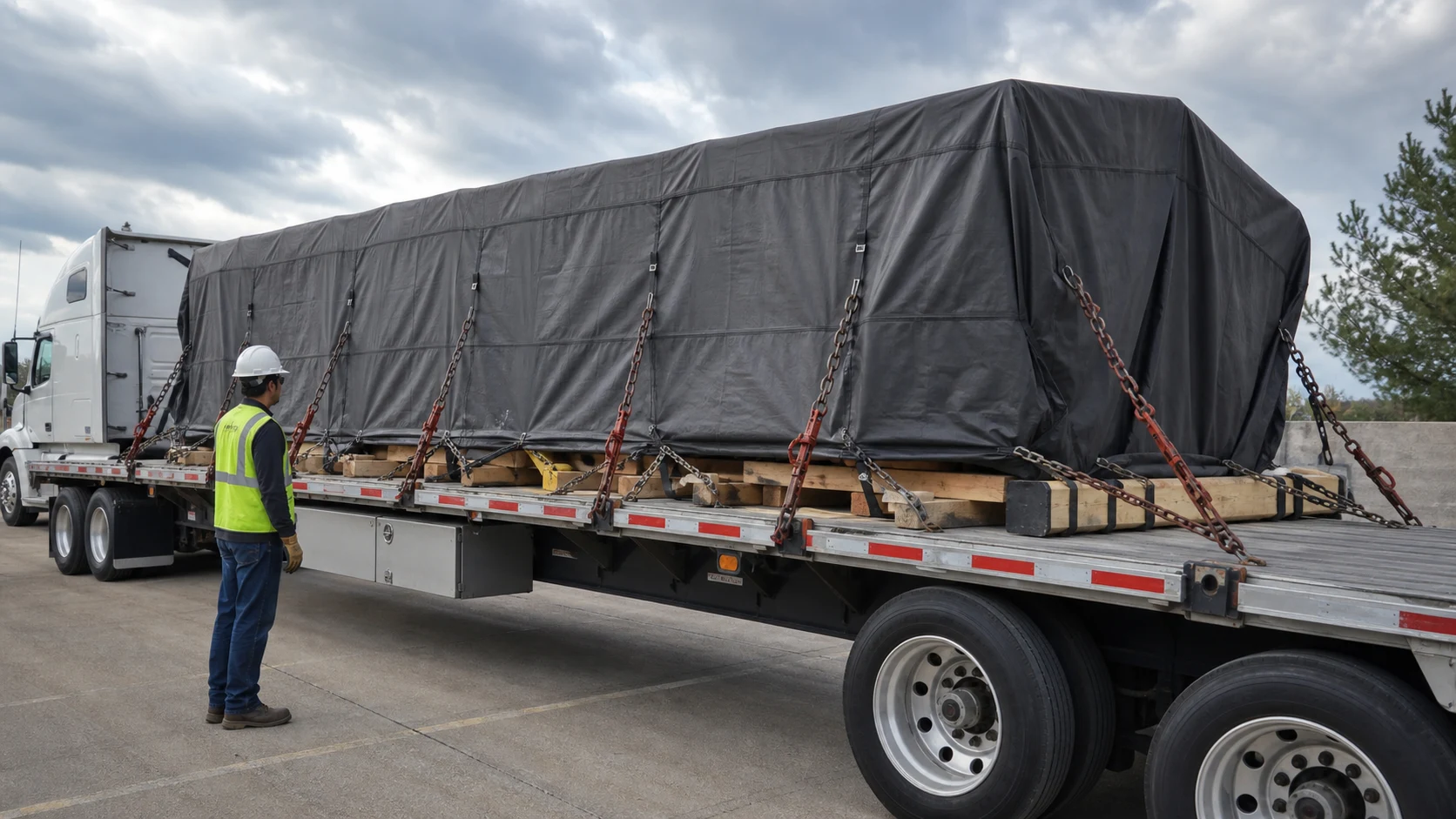
A flatbed move succeeds when the shipper, carrier, and sites agree on the loaded envelope, equipment, securement method, weather protection, and loading conditions before the truck arrives.
Flatbed freight is not simply truckload freight without walls. Removing the enclosure changes the operating problem. The cargo is accessible from the side and above, but it is also exposed to weather, its geometry affects equipment and route choices, and every blocking, tiedown, edge protector, tarp, and attachment point becomes part of the execution plan.
That is why a successful flatbed shipment begins before a carrier quotes it. The shipper has to describe the freight as it will actually travel. The carrier has to select equipment and develop a compliant securement approach. The origin and destination have to be able to handle that exact equipment and load safely.
The practical rule is:
Tender the loaded configuration and the work at both sites—not just the commodity and its weight.
This article is operational education, not legal or engineering advice. The carrier and driver remain responsible for operating the vehicle lawfully, and qualified parties should resolve product-specific lifting, securement, or structural questions.
Start with the loaded envelope
A phrase such as “one machine, 22,000 pounds” is not a flatbed tender. It leaves unanswered most of the facts that determine whether the move is routine, legal, protectable, and executable.
Build a load sheet containing:
- the number of pieces and the dimensions and weight of each piece;
- the overall loaded length, width, and height, including supports and packaging;
- the center of gravity and any known axle-loading sensitivity;
- lift points, support points, ground clearance, and permitted bearing surfaces;
- overhang, projections, sharp edges, wheels, reels, or parts that can articulate;
- approved tiedown or attachment points and areas that cannot take pressure;
- required orientation and any restriction on stacking or top loading;
- sensitivity to rain, road spray, dust, sunlight, salt, condensation, or temperature;
- whether tarps may contact painted, polished, soft, or fragile surfaces;
- commodity-specific regulation, hazardous-material status, and declared value;
- the origin and destination loading method, equipment, hours, and physical constraints.
Use final shipping dimensions, not a drawing of the bare product. Crating, cribbing, dunnage, skid beams, protective frames, exhaust stacks, fixtures, and tarps can change the legal height or width. A late change from a compact machine to the same machine on a tall skid can invalidate the equipment choice and, if the loaded envelope is over legal limits, the route and permit plan.
Photographs help, but they do not replace measurements. Include multiple views, a scale reference, close-ups of lift and attachment points, and a drawing when geometry is not obvious. Mark whether each dimension is measured, manufacturer-supplied, or estimated. The carrier should know which values still require field verification.
If the loaded dimensions or weights exceed applicable limits, move from ordinary flatbed planning into a controlled oversize and overweight permitting process. A flat deck does not create an exemption from vehicle size and weight rules.
Choose equipment from the load and the sites
“Flatbed” describes a family of open-deck equipment. The useful question is which configuration can carry the loaded freight, remain within axle and dimensional limits, clear the route, and be loaded and unloaded at both ends.
Common configurations include:
- standard flatbed, for cargo that fits the deck height and can be loaded from the side, rear, or above;
- step deck or drop deck, when lower deck height creates additional vertical clearance;
- double-drop or low-deck equipment, for tall or concentrated project cargo, subject to well length, ground clearance, and loading method;
- removable-gooseneck equipment, when machinery needs to be driven or winched onto the deck from ground level;
- extendable equipment, for long freight whose support and overhang cannot be handled on a standard deck;
- sliding-tarp or curtain-style open-deck systems, when the cargo benefits from faster enclosure but still fits the system's internal geometry and loading constraints.
Equipment selection is not a lookup by gross cargo weight. A trailer may have enough nominal payload yet be wrong because the weight is concentrated, the center of gravity is high, the cargo will not distribute across the axles, the well is too short, or the destination cannot unload that configuration.
Ask for the proposed deck height, usable deck or well dimensions, axle configuration, rated capacity, and loading approach. For concentrated loads, the carrier may need manufacturer information or an engineered distribution plan. For low equipment, review breakover angle, railroad crossings, steep entrances, crowned roads, and uneven jobsites—not only bridge height.
The Federal Highway Administration's summary of federal vehicle size rules is useful context, but state, route, and permit conditions still have to be checked for the actual combination. Do not turn a federal baseline into a universal equipment rule.
Treat securement as a system
Securement is not synonymous with adding straps until the load looks busy. It combines load placement, vehicle structures, blocking and bracing, dunnage, chocks, tiedowns, anchor points, edge protection, and the cargo's ability to withstand those forces.
The current federal performance requirements in 49 CFR Part 393, Subpart I require cargo to be contained, immobilized, or secured so it does not leak, spill, blow, fall, or shift enough to affect vehicle stability or maneuverability. The rules also address tiedown working-load limits, component condition, edge protection, rolling cargo, and minimum tiedown arrangements.
An operator should understand five implications.
1. Placement comes before tiedowns
The cargo's position affects axle weights, handling, and securement geometry. A load can be strongly tied to the deck and still create an unlawful axle condition or unstable combination. Confirm the actual placement and axle plan before treating the trailer as ready.
2. The aggregate working-load limit is not a strap-count shortcut
Federal rules include an aggregate working-load-limit calculation, but tiedown count also depends on length, weight, whether the cargo is blocked against forward movement, how the tiedowns attach, and whether a commodity-specific rule applies. Component ratings, anchor points, and routing matter. “One strap per X pounds” is not a defensible universal standard.
3. Edge protection protects the securement, not just the product
Where a tiedown can be cut or abraded by cargo, the rule requires edge protection resistant to the relevant damage. The protector should remain in position during transport. Product padding that slides away or collapses under tension is not automatically adequate tiedown protection.
4. Commodity-specific rules can supersede the general arrangement
Subpart I contains additional requirements for commodities including logs, dressed lumber, metal coils, paper rolls, concrete pipe, intermodal containers, vehicles, heavy machinery, and boulders. The FMCSA cargo-securement overview maps those commodity sections and summarizes the underlying performance criteria. Identify the commodity provision before building the plan.
5. Securement has to remain inspectable
Blocking, attachment points, and tiedowns should be accessible for the driver's required checks. A tarp or cover should not make meaningful inspection impossible without that consequence being understood and managed.
The carrier should define the securement concept; the driver must evaluate the actual load and equipment. The shipper should supply accurate product limits and avoid directing a method that conflicts with safe operation. If the load has unusual geometry, fragile attachment points, high value, or serious consequences of movement, involve a qualified securement or engineering professional before dispatch.
Loading responsibility and operating responsibility are different
Commercial agreements can assign who supplies the crane, forklift, dunnage, tarps, labor, or securement material. They do not erase the carrier's and driver's duties before operating.
FMCSA explains that a driver does not always have to load, block, brace, and tie down the cargo personally, but must be able to determine that the freight is properly loaded and secured and make adjustments when needed. See FMCSA's cargo-loading interpretation.
Under 49 CFR § 392.9, the vehicle may not be operated unless the cargo is properly distributed and adequately secured and related equipment is secured. The driver generally must inspect the cargo and securement within the first 50 miles and reexamine it after specified time, distance, or duty-status triggers. The regulation contains limited exceptions for sealed vehicles and cargo impracticable to inspect; an ordinary open-deck load should not be planned around those exceptions.
The operating workflow should therefore give the driver:
- the load sheet and relevant product instructions;
- safe access to inspect the cargo, deck, blocking, and attachment points;
- authority and time to request changes;
- a contact who can resolve a product or loading question;
- a safe place for the first required recheck;
- replacement or adjustment materials appropriate to the plan.
A “shipper load and count” notation or a customer instruction does not make an unsafe configuration operable. Contract language assigns commercial work and risk; it is not a substitute for the release check.
Define weather protection as a specification
“Tarped” is ambiguous. One party may hear full weather enclosure; another may hear a top cover; a third may assume tarps are carried but used only if the driver considers them necessary.
Write the required outcome:
- fully covered from precipitation and road spray;
- top-covered only;
- weather-resistant rather than watertight;
- protected from dust, ultraviolet exposure, or road salt;
- no tarp contact with specified surfaces;
- ventilation or condensation controls required;
- cover removed only in a designated area at delivery;
- photographs required before covering and after removal.
Tarping protects the product; it is not primary cargo securement. The securement plan must stand on its own.
Plan the cover system before the truck arrives. Sharp projections may require caps or padding so they do not tear the tarp. Soft or finished surfaces may require a frame that keeps the cover off the product. Tall or irregular loads may need a different equipment choice. If a sliding-tarp system is proposed, verify its internal width, height, door or opening geometry, and ability to close around the actual load.
Also plan the human work. Climbing on cargo or working at height to spread heavy tarps creates fall and manual-handling exposure. Wind, ice, rain, and darkness can turn a routine cover into an unacceptable task. Decide where and how covering will occur, which fall-prevention method or ground-based process will be used, and who has stop-work authority.
Make the origin ready before appointment time
The truck's arrival should be the beginning of execution, not the first site survey.
Confirm:
- gate, road, and turning access for the tractor-trailer configuration;
- firm, level ground with adequate overhead and lateral clearance;
- a loading zone separated from pedestrians and unrelated vehicles;
- whether side, rear, top, or drive-on loading is required;
- a crane or forklift with suitable rated capacity, reach, forks, attachments, and operators;
- safe support for an uncoupled trailer when applicable;
- sufficient lighting and a weather plan;
- correct dunnage, cribbing, chocks, edge protection, and securement materials;
- a designated tarping or covering area;
- space for the driver to inspect and for the load to be repositioned;
- a scale or other axle-verification plan when weight distribution is sensitive;
- a decision-maker authorized to stop or correct the loading process.
OSHA's trucking loading and unloading resources emphasize material-specific procedures and separation from loading hazards. Its powered-industrial-truck load-handling guidance also addresses trailer movement, floor condition, clearance, and support for uncoupled semitrailers. These are starting points; the employer and site must conduct the hazard assessment for the actual operation.
Never assume “a forklift is available” means the site can load the freight. Capacity at a short load center does not prove capacity at the required reach. Standard forks may not match engineered lift points. A forklift that can lift the weight may lack the mast height, attachment, aisle, surface, or trailer access to do the job safely.
Give the destination the same engineering attention
Many flatbed failures are merely deferred origin failures. The freight was loaded with a crane, but the consignee has only a small forklift. The low trailer clears the highway, but it bottoms out at the jobsite entrance. The tarp can be removed, but only by climbing on the load in an active yard.
Repeat the readiness check for the exact receiving site:
- entrance geometry, surface, slope, overhead obstructions, and staging area;
- appointment, gate, induction, and site-safety requirements;
- receiving equipment, operator, rigging, and verified capacity;
- load orientation relative to the unloading approach;
- space to remove securement and weather protection safely;
- temporary storage, laydown, or cribbing after unloading;
- responsibilities for packaging, tarp, dunnage, and debris;
- exception contact and after-hours limits.
If final delivery is to a construction site, farm, mine, or unpaved facility, obtain current site information close to the move. Conditions can change after rain, grading, utility work, or other construction. The carrier should not be expected to discover an impassable entrance with a loaded combination at the gate.
Site information also affects price. Crane wait, driver assistance, jobsite induction, limited hours, tarping labor, layover, permits, pilot vehicles, and redelivery are different work. Price them explicitly using the freight-rate component framework.
Use a release gate, not an optimistic appointment
Before loading begins, the dispatcher or move owner should confirm:
- Cargo identity: the pieces match the tender and are ready.
- Loaded envelope: final dimensions, weight, center of gravity, and orientation are known.
- Equipment: the dispatched tractor-trailer configuration matches the plan.
- Sites: origin and destination can perform their assigned work.
- Securement: the carrier has an applicable method, rated components, and inspection access.
- Protection: the weather and surface-protection specification can be met safely.
- Legality: route, dimensions, weights, and any permits or conditions are resolved.
- Documents: contacts, instructions, declared value, and regulated-goods documents are complete.
After loading, capture the cargo and securement from all sides, attachment points, blocking, labels or serial numbers, and any pre-existing condition. Record final measurements where the load is dimension-sensitive. The driver should have a clear acceptance or exception path, not pressure to leave because a crane crew is waiting.
If damage or shortage is found later, those records become part of the freight-claims evidence file. They do not decide liability by themselves, but they preserve facts that are expensive or impossible to recreate after unloading.
What to ask a flatbed carrier
A useful carrier conversation tests the operating plan:
- Which equipment configuration are you proposing, and why?
- What loaded dimensions and weights is that decision based on?
- Does this commodity have a specific securement rule?
- What product information do you need to finalize blocking and tiedowns?
- Who provides dunnage, edge protection, tarps, and specialized equipment?
- How will weather protection be applied without damaging the product or exposing people to unnecessary risk?
- Where can the driver complete the first securement recheck?
- What conditions would cause the driver to reject or pause the load?
- Are permits, escorts, route surveys, or special site access likely?
- Which subcontractors or carriers will physically move the load?
- What photographs and status events will be retained?
- What is excluded from the rate?
Apply the broader motor-carrier vetting process, then add open-deck experience relevant to the commodity, equipment, route, and loading method. A carrier that moves steel coils every day is not automatically the right carrier for a fragile fabricated module, even when both use a flatbed.
Operating takeaway
Flatbed performance is designed through the loaded envelope, equipment, placement, securement, protection, and site plan. The transportation rate comes after those facts, not before them.
Measure the freight as shipped. Select equipment for the load and both sites. Let the carrier and driver control safe, compliant operation. Specify what weather protection must accomplish. Verify origin and destination readiness. Release the move only when the actual load matches the plan.
Use the wider map of how freight moves across America to place open-deck service in the network, then use UniteCargo's trucking company directory to build a candidate list for the same fact-based review.
Sources and further reading
- eCFR: 49 CFR Part 392, Driving of Commercial Motor Vehicles
- eCFR: 49 CFR Part 393, Subpart I, Protection Against Shifting and Falling Cargo
- FMCSA: Cargo Securement Rules
- FMCSA: Interpretation on Driver Loading and Securement Responsibility
- OSHA: Trucking Industry Loading and Unloading
- OSHA: Powered Industrial Trucks—Load Handling
- FHWA: Compilation of Existing State Truck Size and Weight Limit Laws