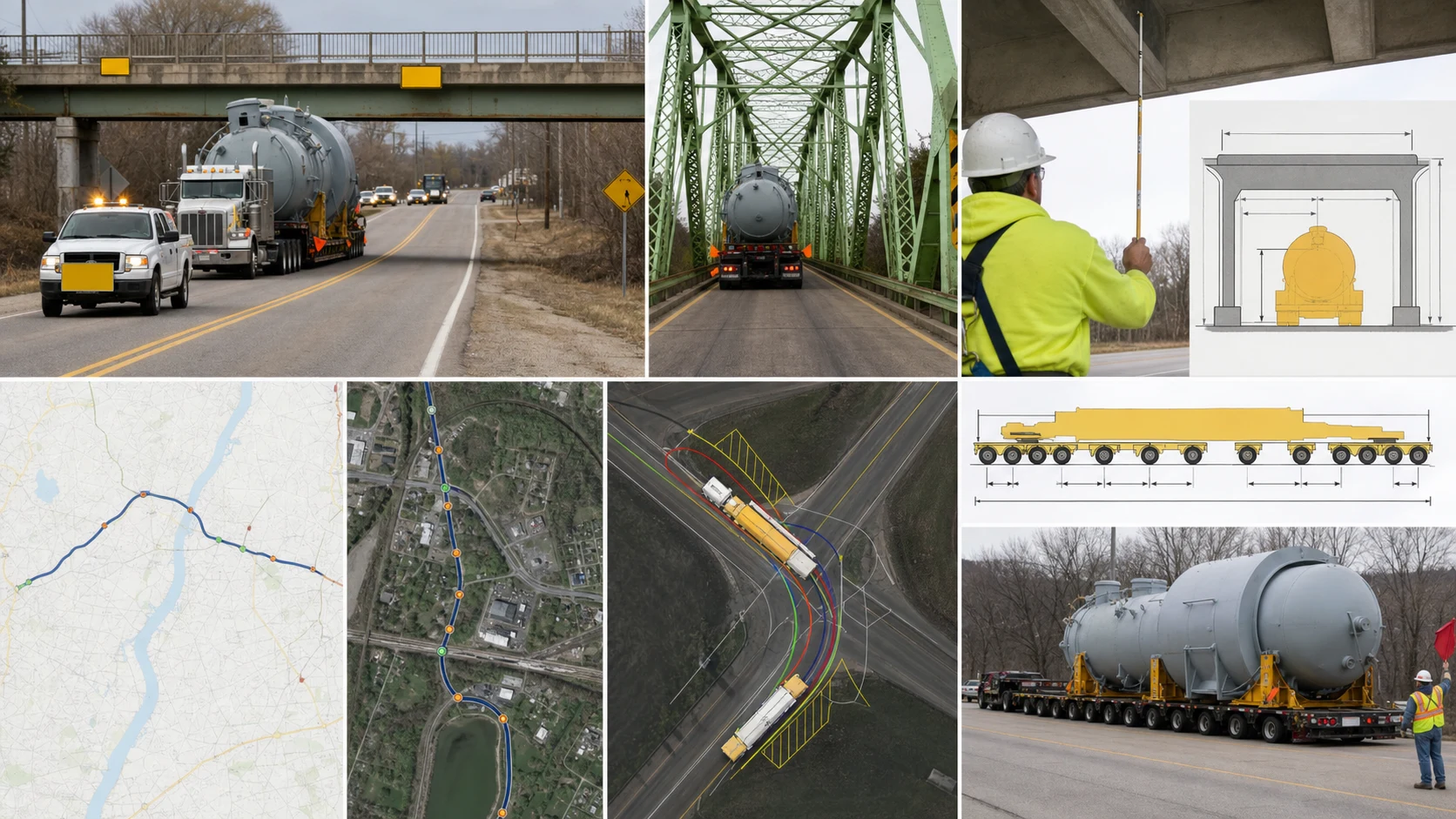
An oversize or overweight permit authorizes one defined vehicle-load configuration under stated route and operating conditions; it is not a transferable national pass.
An oversize or overweight permit does not make a load generally legal. It authorizes a defined vehicle-load configuration to move under stated conditions, often on a specified route, during a specified period, and subject to restrictions that can change from one jurisdiction to the next.
That distinction matters because the permit is usually near the end of the planning process. Before anyone can apply accurately, the team must know the loaded dimensions, gross and axle weights, equipment configuration, route constraints, sites, and movement date. A permit generated from assumptions is not a substitute for that work.
The practical rule is:
Control the configuration, route, and conditions as one release package. If one changes, stop and revalidate the package.
This article provides operational education, not legal, engineering, or permit advice. Requirements vary by jurisdiction and movement. The permittee, carrier, qualified engineers, and issuing authorities must resolve the rules and conditions for the actual load.
There is no federal oversize or overweight permit
The Federal Highway Administration states plainly that the federal government does not issue oversize or overweight vehicle permits; permitting is a state function. FHWA's state oversize/overweight permit contact directory points applicants to the relevant state offices.
For an interstate move, that generally means a permit or authorization review in every state crossed. Depending on the route, separate approvals may also be required from:
- cities, counties, or other local road owners;
- toll-road, bridge, or turnpike authorities;
- ports, terminals, campuses, or industrial facilities;
- utility or railroad parties involved in clearance work;
- other agencies named by an issuing jurisdiction.
The permit chain is only as complete as the route. A state permit does not silently authorize movement on every local street between the state route and the consignee.
Federal size and weight rules still define important baselines. Current 23 CFR Part 658 governs truck size and weight on parts of the federal-aid system. FHWA's compilation of state truck size and weight laws explains, among other things, the federal 102-inch commercial-vehicle width requirement on the National Network and reasonable-access routes, subject to the law's scope and exceptions. It also notes that federal law does not impose a general commercial-vehicle height limit; states set height limits.
Those points are often flattened into bad rules of thumb. A 102-inch width is not a nationwide permit threshold for every road and vehicle. A commonly cited height is not automatically legal in every state or clear on a particular route. A legal gross weight does not prove that every axle group and bridge-formula calculation is legal.
Start with the applicable jurisdictions and road systems, not a laminated national threshold chart.
Classify the exact loaded vehicle, not the cargo in isolation
The permit application concerns the vehicle or combination as loaded. Capture:
- tractor, jeep, dolly, booster, trailer, and axle configuration;
- axle count, axle spacings, axle widths where required, and proposed axle weights;
- gross combination weight;
- loaded overall length, width, and height;
- front, rear, and side overhang;
- cargo weight, dimensions, center of gravity, and placement;
- deck or well height and usable dimensions;
- ground clearance and breakover exposure;
- steering or self-steering axle features;
- proposed equipment identifiers when the jurisdiction or permit requires them;
- origin, destination, requested route, and movement dates.
Use the final support and securement arrangement. Cribbing can increase height. A wider trailer, outrigger, or side-by-side placement can increase width. A tractor, booster, or axle change can alter gross dimensions, axle spacings, turning behavior, and permit calculations.
Do not issue a tender with “approximately” attached to every critical number and then pressure a permit team to meet a fixed ship date. Separate values into:
- verified final;
- engineering or manufacturer value awaiting field confirmation;
- planning estimate not valid for an application.
Estimates can support an early feasibility review. They should not quietly become declared permit facts.
For open-deck equipment, build the configuration using the flatbed load, securement, protection, and site-readiness process. Permitting an equipment choice does not prove the cargo can be safely loaded, secured, protected, or unloaded.
Weight compliance is more than 80,000 pounds
On the Interstate System, federal law generally limits gross vehicle weight to 80,000 pounds, a single axle to 20,000 pounds, and a tandem axle to 34,000 pounds, subject to the bridge formula and statutory exceptions or grandfather rights. But a combination below 80,000 pounds can still violate an axle or axle-group limit.
FHWA's Bridge Formula guide explains why axle count and spacing matter: bridge stress depends on how weight is distributed across a vehicle's length, not just the gross total. The guide demonstrates that both outer and interior groups of consecutive axles may need to be checked.
For operators, the implications are practical:
- Obtain credible piece and total weights before selecting equipment.
- Model cargo position and resulting axle weights.
- Do not assume that adding axles solves every limit; spacing and jurisdiction rules still matter.
- Confirm whether proposed axle weights can be achieved in the field.
- Establish a scale plan when the permitted configuration has little tolerance.
- Keep the scale evidence and reconcile meaningful variance before movement.
Permits may authorize weights above ordinary limits for qualifying movements, but the application and permit conditions govern the actual authorization. A state may also require bridge review, route-specific structural analysis, reduced speed, lane positioning, escort, or other controls.
Divisible versus nondivisible can change the path
FHWA describes a nondivisible load or vehicle, for federal size-and-weight purposes, as one that would have its intended use compromised, its value destroyed, or require more than eight work hours to dismantle using appropriate equipment if separated. The applicant bears the burden for the dismantling-time basis.
That is not permission to call a commercially inconvenient breakdown “nondivisible.” Nor is it a complete substitute for a state's definition and permit policy.
Early in planning, ask:
- Can the cargo be separated without compromising its intended use or value?
- Are removable attachments included only for convenience?
- What work, equipment, and time would disassembly actually require?
- Does the destination need the product assembled?
- Which state-specific standard and documentation apply?
The answer can affect permit availability, permitted weight, route, equipment, and cost. Resolve it before the team commits to a transport configuration.
Route engineering is a separate discipline
A routing engine can find a road between two points. It cannot, by itself, prove that the permitted combination can traverse that road under current conditions.
The FHWA pilot/escort route-planning manual explains that permits frequently specify the route, that a route survey may be required, and that the survey must identify hazards and contingency plans. It also warns that movement off a permitted route can invalidate the permit in many states.
A route review or survey may need to examine:
- bridge capacity and any crossing conditions;
- vertical clearance at bridges, signs, signals, utilities, trees, and structures;
- lateral clearance through work zones, barriers, ramps, and narrow roads;
- turn radius, off-tracking, swept path, and lane encroachment;
- grade, traction, braking, and engine-cooling exposure;
- ground clearance at railroad crossings, crowns, dips, and entrances;
- construction, closures, seasonal restrictions, and temporary traffic control;
- safe staging, fuel, parking, and inspection locations;
- urban time restrictions, school zones, events, and curfews;
- final-mile access to the origin and destination;
- utility lifts, sign removal, law-enforcement traffic control, and restoration work.
The survey must use the actual—or faithfully modeled—loaded configuration. A route that worked for a load of similar weight can fail for a taller load, a longer wheelbase, different axle spacing, or lower ground clearance.
Run the survey close enough to movement to reflect current construction and restrictions, while leaving enough time to solve what it finds. Verify critical conditions again before dispatch. A database clearance is a screening input, not physical proof that an overheight load will clear today.
Read the permit as an operating instruction
Do not let the permit live only in an email attachment held by an office coordinator. Convert every material condition into the move plan and driver briefing.
Depending on the jurisdiction and permit, conditions can address:
- authorized vehicle, trailer, axle, and load configuration;
- approved route and direction of travel;
- effective dates and single-trip or recurring authority;
- daylight, day-of-week, holiday, or urban travel windows;
- weather, visibility, wind, or road-condition limits;
- required signs, flags, lights, and warning devices;
- pilot or escort vehicles and their positions;
- speed, lane, bridge, spacing, or stopping conditions;
- law-enforcement, utility, or traffic-control coordination;
- notification, check-in, or document-carrying requirements.
These are not generic nationwide conditions. For example, the Washington State Department of Transportation's permit resources, Texas Department of Motor Vehicles' oversize/overweight program, and Caltrans transportation-permit program each publish state-specific permit types, instructions, or restrictions. Their differences are the point: the issuing jurisdiction and the permit for the move control.
Build a one-page condition sheet that references, but does not replace, the complete permit. Include the route, dates, travel windows, escort arrangement, special bridge or lane instructions, required contacts, and stop-work triggers. Every party should know where the authoritative permit resides and how amendments are communicated.
Escorts are a control, not a universal dimension table
Pilot or escort vehicle requirements vary by state, route, dimensions, load characteristics, and permit conditions. Some movements may require front, rear, or multiple escorts; height-sensitive moves may require a height pole; certain locations may require law-enforcement support.
Do not source escorts from a generic “over X feet” assumption. Ask the applicable authorities and permit team:
- Which escorts are required for each jurisdiction and segment?
- What operator, vehicle, equipment, or certification requirements apply?
- Who performs the pre-trip briefing?
- Which communications method and terminology will the team use?
- Who leads at route transitions and jurisdiction boundaries?
- What is the stop command, and who may issue it?
- How are hazards, traffic control, utility work, and railroad crossings coordinated?
- What happens if an escort, device, or communication link fails?
The movement team should receive the same configuration, route, and condition package. An escort should not discover at origin that the load is taller than the surveyed configuration.
Establish one change-control rule
The most important control is simple:
No unreviewed change to cargo, placement, equipment, axles, route, date, or permit condition.
Changes that appear minor can be permit-critical:
- replacing the assigned tractor;
- changing trailer or axle configuration;
- adding cribbing or packaging;
- moving the cargo on the deck;
- changing the origin gate or destination entrance;
- detouring around traffic or construction;
- missing the authorized travel date or window;
- substituting an escort or removing required equipment.
When a change occurs, the move owner should record it, stop release, and send it to the carrier or permittee, permit specialist, route-survey lead, and qualified engineer as applicable. The designated authority decides whether the existing permits and analysis remain valid, need amendment, or must be replaced.
The driver should never have to improvise a detour because a navigation app shows a faster road. If the permitted route is blocked, stop in a safe location and use the permit's or carrier's escalation process.
Assign owners without transferring accountability by accident
A permit service can prepare and submit applications. A broker can coordinate providers. A shipper can supply cargo data. None of those roles should be allowed to blur who is the permittee and who owns each decision.
Use a responsibility map:
| Control | Primary owner | Required inputs or approvals |
|---|---|---|
| Cargo dimensions, weight, center of gravity | Shipper or cargo owner | Manufacturer, engineer, packaging team |
| Equipment and load placement | Carrier | Shipper data, equipment specialist, engineer as needed |
| Permit applications and compliance | Named permittee/carrier | Permit service and issuing authorities |
| Route survey and feasibility | Carrier-designated qualified party | Permit conditions, escorts, engineer, road owners |
| Site readiness | Origin and destination site owners | Carrier equipment and loaded-envelope data |
| Escort and traffic-control plan | Carrier/permittee | State and local requirements, escort providers |
| Release and change control | Named move owner | All control owners |
Confirm this map contractually and operationally. “The permit company is handling it” is not a release status.
When using a broker or managed transportation provider, verify the physical carrier and authority through the motor-carrier vetting workflow. Heavy-haul specialization should be demonstrated for the equipment, configuration, states, and operating conditions involved.
Price the whole permitted movement
Heavy-haul comparisons fail when one bid includes route and site work while another presents only tractor-trailer linehaul.
Normalize:
- specialized tractor, trailer, axle, jeep, dolly, and booster equipment;
- mobilization and repositioning;
- permit fees and permit-administration charges;
- engineering, bridge analysis, and route surveys;
- pilot cars, height poles, law enforcement, and traffic control;
- utility lifts, sign or barrier work, and restoration;
- cranes, rigging, loading, unloading, and site labor;
- staging, secure parking, fuel routing, and escorts' travel;
- waiting, curfews, weather holds, layover, and detention;
- tolls and route-specific charges;
- tarping, protection, dunnage, and securement;
- scale tickets and configuration changes;
- cancellation, amendment, and redelivery exposure.
Use the broader freight-pricing framework to expose assumptions and exclusions. The lowest linehaul can be the highest total move cost when it excludes necessary control work.
Use a permit-release checklist
Release only when the team can answer yes:
- Is the cargo configuration final, measured, and documented?
- Are equipment, axle spacings, axle weights, and gross dimensions final?
- Has divisible or nondivisible status been resolved where relevant?
- Are all state, local, toll-road, port, or other approvals identified?
- Has the route been approved and surveyed to the required standard?
- Are bridge, clearance, turn, grade, railroad, and site constraints resolved?
- Are permits issued for the correct configuration, route, and dates?
- Have all permit conditions been converted into the operating plan?
- Are escorts, utilities, traffic control, and site resources confirmed?
- Is weather and road condition acceptable within the permit?
- Does every participant have the current controlled document set?
- Is the no-unreviewed-change rule active through delivery?
Retain issued permits, applications, route surveys, configuration drawings, measurement and scale evidence, briefings, approvals, amendments, and exception records. Those documents support compliance review, invoice reconciliation, incident response, and the freight-claims evidence process.
Operating takeaway
The permit is not the plan. It is an authorization produced from a valid configuration and route plan and then carried out under specific conditions.
Measure the final loaded vehicle. Select and model the equipment. Identify every jurisdiction. Survey the actual route. Translate permit conditions into field instructions. Assign accountable owners. Stop and revalidate any change.
That discipline protects the move from the two most expensive assumptions in project freight: that a permit works everywhere, and that a route on a screen is a route the load can actually travel.
Use UniteCargo's trucking company directory to identify prospective heavy-haul providers, then evaluate each candidate against the same configuration, route, permit, and site package.
Sources and further reading
- eCFR: 23 CFR Part 658, Truck Size and Weight
- FHWA: Oversize/Overweight Load Permits and State Contacts
- FHWA: Compilation of Existing State Truck Size and Weight Limit Laws
- FHWA: Bridge Formula Weights
- FHWA: Pilot/Escort Vehicle Operators Training Manual—Route Planning
- WSDOT: Commercial Vehicle Permits
- TxDMV: Oversize/Overweight Permits
- Caltrans: Transportation Permits for Oversize/Overweight Vehicles